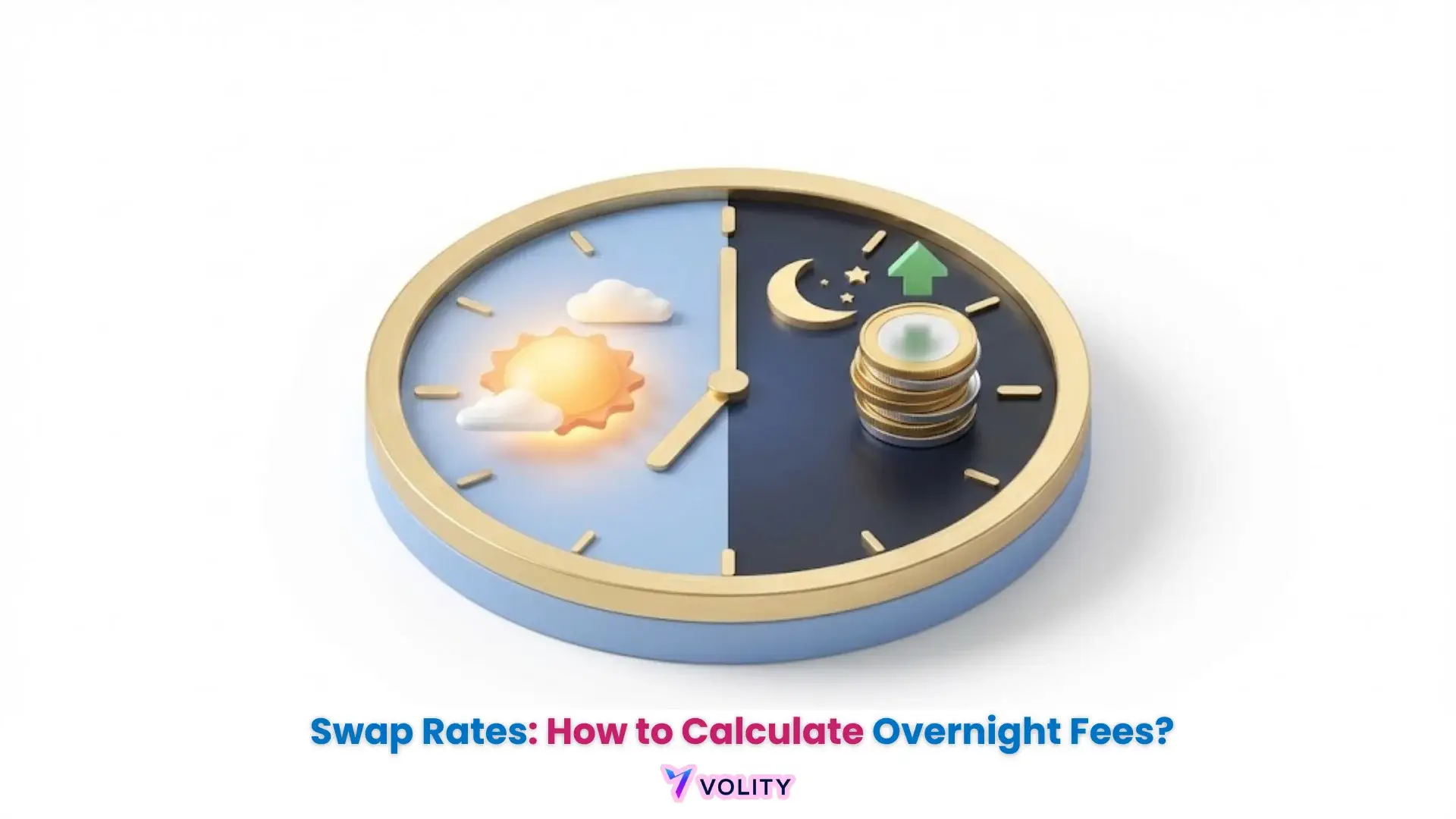
Forex swap rates, also known as rollover interest, are the net interest paid or earned on positions held overnight in the foreign exchange market. These rates are a critical factor for traders, especially those with longer-term strategies, as they directly impact overall profitability. This guide will explain how swap rates are calculated, how they affect your trading account, and provide strategies to manage or even profit from them.
While understanding Forex Swap Rates is important, applying that knowledge is where the real growth happens. Create Your Free Forex Trading Account to practice with a free demo account and put your strategy to the test.
Understanding Forex Swap Rates
Forex swap rates, also referred to as rollover interest, are the interest adjustments applied to trading positions held open past the daily market close, typically 5 PM Eastern Standard Time. These charges or credits are a fundamental aspect of foreign exchange trading, impacting a trader’s overall profitability, especially for those holding positions for more than a single day. Understanding these rates is crucial for managing unexpected costs and optimizing long-term trading strategies. This overnight financing fee reflects the interest rate differential between the two currencies in a pair. Traders either pay or receive this interest, depending on the currencies involved and the direction of their trade. These rates are a standard component of forex trading, directly impacting profits or losses when positions are maintained across days.
The Basics
Forex swap rates, also known as rollover interest, are the interest adjustments applied to currency positions held open overnight. When a trader keeps a position open beyond the official market close, they are essentially borrowing one currency to buy another. This process incurs an interest cost on the borrowed currency and earns interest on the held currency. The net difference between these two interest rates, adjusted by the broker, constitutes the swap rate. This mechanism accounts for the time value of money in the interbank market.
Why do brokers charge swap fees?
Brokers charge swap fees because forex trading involves the simultaneous buying and selling of currencies, each with its own interest rate set by its respective central bank. When a trader holds an overnight position, they are effectively exposed to these interest rate differentials. Brokers pass on these costs or credits, which originate from the underlying interbank market where the actual currency exchanges occur. This ensures that the financial implications of holding different interest-bearing assets are accurately reflected in the trader’s account.
How are swap rates calculated?
The calculation of a swap rate is primarily based on the interest rate differential between the two currencies in a pair, adjusted for the broker’s administrative fee or spread. This differential represents the difference between the interest rate of the currency being bought and the currency being sold. A positive differential can result in a credit (earning interest), while a negative differential leads to a debit (paying interest).
Interest Rate Differential + Broker Markup
The fundamental principle behind swap rate calculation is the interest rate differential. This is the difference between the central bank interest rates of the base currency and the quote currency in a currency pair. For instance, if you buy EUR/USD, you are effectively borrowing USD (lower interest rate currency) to buy EUR (higher interest rate currency). The broker then applies a small markup or administrative fee to this differential, which covers their costs and provides a profit margin. This results in the final swap rate that is credited or debited to your trading account.
What is a positive/negative swap?
A positive swap occurs when a trader earns interest on their overnight position. This typically happens when buying a currency with a higher interest rate and simultaneously selling a currency with a lower interest rate. For example, if you hold a long position in AUD/JPY, you might receive a positive swap because the Australian dollar often has a higher interest rate than the Japanese Yen. Conversely, a negative swap means the trader pays interest. This is common when holding a short position in a currency with a higher interest rate against one with a lower rate, or a long position where the purchased currency has a lower interest rate. For instance, a long position in EUR/USD might incur a negative swap because the Eurozone interest rates have historically been lower than the US dollar’s.
Ready to Elevate Your Trading?
You have the information. Now, get the platform. Join thousands of successful traders who use Volity for its powerful tools, fast execution, and dedicated support.
Create Your Account in Under 3 MinutesHow do swap rates affect trading?
Swap rates significantly affect trading by introducing an additional cost or revenue stream for positions held overnight. For short-term day traders, the impact is minimal as positions are closed before rollover. However, for swing traders or those employing longer-term strategies, accumulated swap fees can substantially erode profits or improve them. Understanding this impact is crucial for proper risk management and strategy selection.
Can you profit from swap rates (carry trade)?
Yes, traders can profit from swap rates through a strategy known as the carry trade. This involves buying a currency with a high interest rate and simultaneously selling a currency with a low interest rate, aiming to earn the interest rate differential as a positive swap credit. A common example is going long on AUD/JPY, where the Australian dollar typically offers a higher yield than the Japanese Yen. While potentially profitable, carry trades are not without risk. Changes in interest rates or sudden currency depreciation can quickly negate any accrued interest, making risk management paramount. Many traders still find carry trade viable, but its profitability fluctuates with global economic conditions and central bank policies.
What factors influence swap rates?
FX swap rates are significantly influenced by central bank interest rate policies, which directly impact the interest rate differential between currency pairs. Any change in a central bank’s benchmark rate, such as a rate hike or cut, immediately alters the differential and, consequently, the swap rates. Economic data releases, like inflation reports or employment figures, can also influence market expectations for future rate changes, leading to shifts in market volatility and swap rates. Geopolitical events and overall market sentiment can also cause temporary fluctuations as traders adjust their positions.
Triple Swap Wednesday Explained
Understanding Triple Swap Wednesday is crucial for short-term traders and those managing positions over the weekend, as it can significantly impact overnight costs or credits. A triple swap or rollover occurs on Wednesday nights (server time) for most forex brokers, where three days’ worth of swap fees are charged or credited to account for the upcoming weekend. This accounts for the fact that banks settle trades two business days after they are initiated, meaning a position opened on Wednesday settles on Friday, and one held over Wednesday night effectively covers Friday, Saturday, and Sunday. This phenomenon can lead to unexpected charges or improved profits if not properly managed. Traders must factor this into their trading week planning, especially if they aim to close positions before the weekend or capitalize on positive swaps.
Where can I find live swap rates?
Live forex swap rates can typically be found directly on your forex broker‘s website or within your trading platform, such as MetaTrader 4 or 5. Brokers usually provide a dedicated section detailing the swap rates for each currency pair, often categorized by long and short positions. These rates are updated regularly to reflect changes in interbank interest rates. It is important to check these sources directly, as swap rates can vary significantly between brokers.
How to Compare Broker Swap Rates (and Why It Matters)
Comparing broker swap rates is crucial, especially if you hold positions overnight or engage in carry trade strategies. High negative swap rates can quickly erode profits, while favorable positive rates can boost them. Myfxbook.com offers a comprehensive tool for comparing forex broker swaps, allowing traders to see which brokers offer the most competitive rates for various currency pairs. This comparison helps address the common pain point of “My broker’s swap rates seem high, how do I check others?” By using a forex swap calculator alongside broker-published rates, traders can make informed decisions, ensuring their choice of broker aligns with their trading strategy and minimizes unnecessary costs.
| Broker Feature | Broker A | Broker B | Broker C |
| EUR/USD Long Swap | -0.75 | -0.90 | -0.82 |
| EUR/USD Short Swap | +0.20 | +0.15 | +0.18 |
| AUD/JPY Long Swap | +1.50 | +1.45 | +1.55 |
| AUD/JPY Short Swap | -2.00 | -2.10 | -1.95 |
| Spread (Avg. EUR/USD) | 1.2 pips | 1.0 pips | 1.3 pips |
| Triple Swap Day | Wednesday | Wednesday | Wednesday |
Using a Forex Swap Calculator for Accurate Planning
A forex swap calculator is an invaluable tool for traders to estimate the exact overnight rollover fees or credits for any given position. These calculators typically require inputs such as the currency pair, trade size, account currency, and whether it’s a long or short position. By using a swap calculator, traders can accurately plan their trades, factor in potential costs or earnings, and better manage their risk exposure. This proactive approach helps avoid surprises and ensures that overnight fees do not negatively impact overall profitability.
Common Mistakes and Pitfalls with Forex Swap Rates
Many beginner and intermediate traders overlook the cumulative impact of negative swap rates or mismanage positions around rollover times, leading to avoidable losses. A common mistake is neglecting to check the swap rates before holding a position overnight, especially when dealing with smaller profits that can quickly be eaten away by accumulating negative swaps. Another pitfall is misunderstanding the Triple Swap Wednesday rule, leading to unexpected charges when holding positions over the weekend. Failing to account for these costs in overall risk exposure can significantly impact a trading account, turning potentially profitable trades into losing ones. Proactive planning and regular monitoring of swap rates are essential to avoid these errors.
Turn Knowledge into Profit
You've done the reading, now it's time to act. The best way to learn is by doing. Open a free, no-risk demo account and practice your strategy with virtual funds today.
Open a Free Demo AccountBeyond Basic Swap Rates
For sophisticated traders, understanding concepts like forward points and the theoretical ‘risk-free rate’ provides a more nuanced view of market pricing and hedging strategies related to swaps. Forward points are the difference between the spot exchange rate and the forward exchange rate for a currency pair. They are essentially a reflection of the interest rate differential between the two currencies over a specific period, discounted to the spot rate. Market participants use forward points to price currency forward contracts and to understand the market’s expectation of future spot rates. This concept is vital for advanced hedging strategies. Furthermore, the risk-free rate, a theoretical interest rate that an investor would expect from an absolutely risk-free asset, underpins the interest rate differentials that drive swap calculations. While purely theoretical, it provides a benchmark for understanding the fundamental drivers of currency pricing.
Bottom Line
Forex swap rates are an unavoidable component of overnight trading, acting as either a cost or a potential profit source. Understanding their calculation, the impact of Triple Swap Wednesday, and how to leverage carry trades is essential for effective risk management and maximizing profitability. By actively monitoring broker rates and utilizing swap calculators, traders can integrate these fees into their strategy rather than being surprised by them.
Key Takeaways
- Forex swap rates are interest adjustments on positions held overnight, reflecting currency interest rate differentials.
- They can be positive (credit) or negative (debit), significantly impacting long-term trading profitability.
- Triple Swap Wednesday charges or credits three days’ worth of fees to account for weekend settlement.
- Carry trade strategies aim to profit from positive swap rates by holding higher-yielding currencies.
- Always check broker swap rates and use a swap calculator for accurate trade planning and risk management.