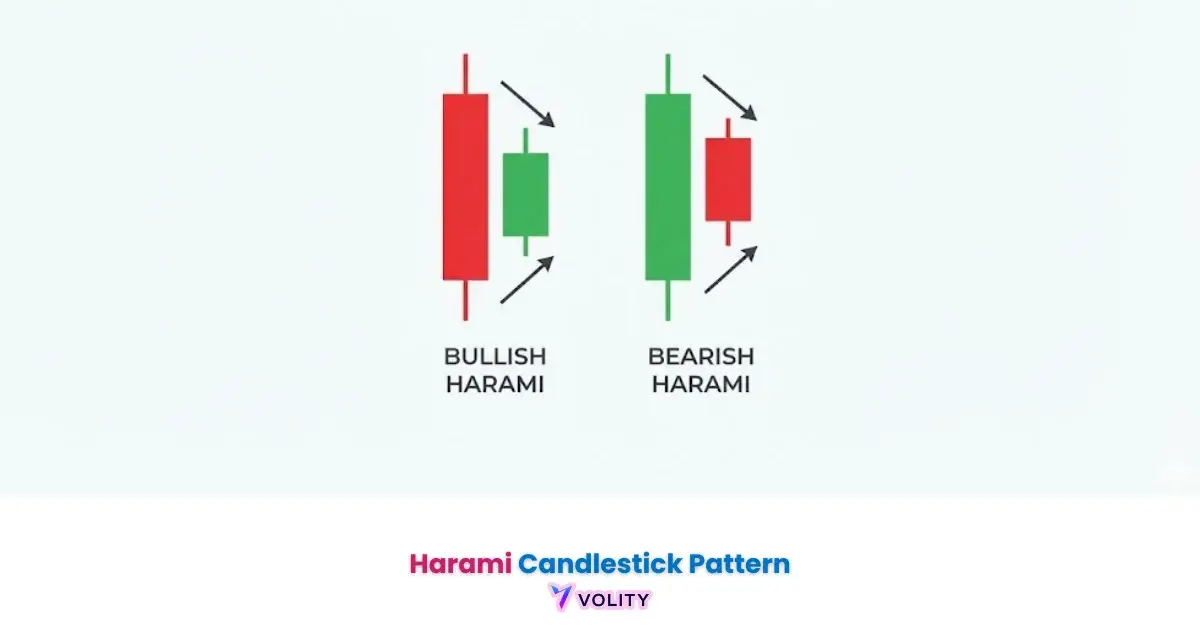
The Harami candlestick pattern is a two-candle reversal formation indicating a potential shift in market momentum. This pattern, characterized by a smaller “baby” candle nestled within a larger “mother” candle, suggests indecision and a weakening of the current trend. This guide will teach you to identify bullish and bearish Harami patterns, understand their signals, and apply effective trading strategies, including precise entry, exit, and risk management techniques.
While understanding Harami Candlestick Pattern is important, applying that knowledge is where the real growth happens. Create Your Free Forex Trading Account to practice with a free demo account and put your strategy to the test.
What is a harami candlestick pattern?
A harami candlestick pattern is a two-candle formation signaling a potential trend reversal, characterized by a small candle completely enclosed within the body of a larger, preceding candle. This pattern indicates a deceleration of the current trend’s momentum, suggesting that the prevailing force (buyers or sellers) is losing its grip on the market.
Originating from Japanese candlestick charting, the term “harami” translates to “pregnant woman,” visually representing the smaller candle (the “baby”) nestled within the larger one (the “mother”).
Mother and Baby Candles
The core of the harami candlestick pattern lies in the distinct relationship between its two candles. The first, larger candle is known as the “mother candle,” reflecting the dominant market sentiment. Following this, a smaller candle, the “baby candle,” forms, with its entire body (open to close) positioned within the real body of the mother candle. This configuration is generally considered a two-candle reversal pattern where the smaller ‘baby’ candle is completely engulfed by the body of a larger ‘mother’ candle. The baby candle often has a small real body, indicating indecision.
A Potential Trend Reversal
The harami pattern fundamentally signals a potential trend reversal. When it appears, it suggests that the prior strong trend is losing momentum and a shift in market sentiment may be imminent. This weakening of the previous trend can be interpreted as the market pausing to consolidate before potentially changing direction. It indicates a potential reversal, not a guaranteed one.
Identifying Bullish and Bearish Harami Patterns
Identifying the harami candlestick pattern on a candlestick chart involves recognizing specific visual cues related to the preceding trend and the two-candle formation. The pattern can be either bullish or bearish, depending on the market’s prior direction and the colors of the candles involved. Accurately interpreting the signal requires understanding these distinctions.
Signaling a Potential Uptrend
A bullish harami pattern emerges during a downtrend, signaling a potential reversal to an uptrend. Its formation consists of two candles: a large bearish (red or black) mother candle, followed by a smaller bullish (green or white) baby candle that opens higher and closes lower than the previous close, with its entire body contained within the mother candle. This suggests selling pressure is diminishing, and buying pressure is starting to emerge, challenging the established downtrend.
Signaling a Potential Downtrend
Conversely, a bearish harami pattern appears during an uptrend, indicating a potential reversal to a downtrend. Its formation involves a large bullish (green or white) mother candle, followed by a smaller bearish (red or black) baby candle that opens lower and closes higher than the previous close, with its entire body contained within the mother candle. This highlights a psychological shift where optimism from the prior uptrend meets profit-taking.
How to Trade the Harami Pattern
Trading with a harami pattern requires a well-defined trading strategy that incorporates precise entry and exit points, alongside robust risk management techniques. While the pattern provides a potential signal, successful trading relies on confirmation and disciplined execution to capitalize on the anticipated trend reversal while minimizing potential losses.
When to Act on a Harami Signal
For a bullish harami, traders typically look for an entry point after a confirmation candle closes above the high of the mother candle. For a bearish harami, an entry is considered after a confirmation candle closes below the low of the mother candle. For increased reliability, traders often seek confirmation of a harami pattern through subsequent price action or other technical indicators like volume or support/resistance levels. Waiting for this confirmation helps filter out weaker signals.
Exit Strategies and Stop-Loss Placement
Effective exit strategies involve setting both profit targets and a stop loss. Profit targets can use previous resistance/support levels. Crucially, stop loss placement is paramount for risk management. For a bullish harami, many traders use a stop-loss order below the low of the mother candle. For a bearish harami, a stop loss is typically placed above the high of the mother candle. This strategic placement protects capital by exiting the trade if the market reverses unexpectedly.
Harami Trading Strategy Summary
| Parameter | Bullish Harami | Bearish Harami |
| Prior Trend | Downtrend | Uptrend |
| Mother Candle | Large Bearish | Large Bullish |
| Baby Candle | Small Bullish | Small Bearish |
| Entry Signal | Close above Mother high | Close below Mother low |
| Stop Loss | Below Mother low | Above Mother high |
| Target | Next Resistance | Next Support |
Ready to Elevate Your Trading?
You have the information. Now, get the platform. Join thousands of successful traders who use Volity for its powerful tools, fast execution, and dedicated support.
Create Your Account in Under 3 MinutesHarami vs. Engulfing Patterns: Key Differences
While both the harami candlestick pattern and the engulfing pattern are prominent reversal patterns in technical analysis, they possess fundamentally opposite structures and implications. Understanding these distinctions is crucial to avoid misinterpretation and to apply the correct trading strategy on a candlestick chart.
The primary difference lies in the relationship between their two candles. The Harami is an “inside bar” pattern, where the second candle is entirely contained within the body of the first. This suggests indecision and a gradual weakening of the prior trend, indicating a pause before a potential shift. In contrast, the engulfing pattern is an “outside bar” pattern, where the second candle’s body completely covers (engulfs) the body of the first candle. This signifies a strong and decisive shift in momentum, often indicating a more powerful and immediate reversal, driven by a sudden surge in buying or selling pressure. Both patterns signal potential reversals, but their internal structure reflects different levels of market sentiment and strength.
Harami vs. Engulfing
| Feature | Harami Pattern | Engulfing Pattern |
| Structure | Baby candle inside Mother | Mother candle inside Baby |
| Signal | Gradual reversal | Strong reversal |
| Candle Rel. | Second candle engulfed | Second candle engulfs |
| Implication | Indecision, pause | Decisive momentum shift |
Harami Cross & Confirmation: Improving Reliability
The harami candlestick pattern, while a valuable indicator, comes with variations and inherent limitations influencing its reliability. Traders must understand these nuances and the importance of confirmation to increase accuracy and mitigate false signals. This helps clarify why patterns might sometimes fail.
Harami Cross: An Improved Reversal Signal
A significant variation is the Harami Cross. This occurs when the second candle, the “baby candle,” is a Doji—indicating strong market indecision. A Doji is a candlestick with a very small or non-existent real body, where the open and close prices are nearly identical. The Harami Cross signals greater indecision than a regular harami and is considered a potentially stronger reversal signal. Its appearance emphasizes a profound struggle, often preceding a more definitive trend shift.
Confirming Harami Patterns with Other Indicators
To improve reliability, confirmation from other technical analysis tools is crucial. Traders should look for increased volume on the confirmation candle, as higher volume suggests stronger conviction. Harami patterns forming near established support and resistance levels tend to be more reliable. For a bullish harami, formation at key support strengthens the signal; for bearish harami, at resistance. Combining with indicators like RSI or MACD can provide further validation.
Limitations and Avoiding False Signals
Despite its potential, no single candlestick pattern, including the Harami, guarantees a trend reversal. False signals are common, especially in volatile or sideways markets. Over-reliance on the harami candlestick pattern alone, without proper confirmation or market context, is a primary reason patterns fail. To avoid false signals, always seek additional confirmation, consider the broader market trend, and never trade solely based on one pattern. The Harami is a piece of the puzzle, not the entire picture.
Advanced Harami Insights for Savvy Traders
Most trading guides often stop at basic identification and interpretation, leaving experienced traders seeking deeper insights. For savvy traders, understanding the psychological underpinnings and empirical validation through backtesting can significantly improve the success rate of trading harami patterns, an aspect frequently overlooked by basic resources. These advanced topics directly address common user frustrations regarding pattern reliability and failure.
Overcoming Emotional Biases
The effectiveness of the harami candlestick pattern is deeply intertwined with the psychology of trading. Emotional biases, such as the fear of missing out (FOMO) or confirmation bias, can lead traders to misinterpret harami signals or ignore critical confirmation steps. For instance, a trader might prematurely enter a trade based on a perceived harami, overlooking the lack of subsequent price action, leading to false signals and failed trades. Developing disciplined execution and emotional control helps traders objectively evaluate the pattern, preventing impulsive decisions that contribute to why their harami patterns fail.
Validating Reliability Across Markets
To truly assess the reliability of the harami candlestick pattern, especially in diverse markets like crypto or forex, backtesting is an essential tool. Backtesting involves applying a trading strategy to historical data to see how it would have performed. For harami patterns, this means identifying past occurrences, executing hypothetical trades based on defined rules (entry, exit, stop loss), and analyzing the results. This empirical approach helps traders understand the pattern’s effectiveness across different assets and timeframes, providing data-driven insights into its profitability and potential for false signals. Backtesting can determine if a harami strategy is reliable on crypto by testing it against specific crypto pairs.
Turn Knowledge into Profit
You've done the reading, now it's time to act. The best way to learn is by doing. Open a free, no-risk demo account and practice your strategy with virtual funds today.
Open a Free Demo AccountCommon Harami Trading Challenges & Solutions
Even with a solid understanding, traders frequently encounter specific challenges applying the harami candlestick pattern in real-world scenarios. Expert solutions improve trading outcomes. Users often question why their harami patterns fail, their reliability on crypto, and how to differentiate them.
Misinterpreting Harami vs. Similar Patterns
A frequent challenge for traders is confusing the harami candlestick pattern with other similar formations, particularly the engulfing pattern. While both signal potential reversals, their structural differences are critical. The Harami is an “inside bar” where the second candle is smaller and contained within the first, indicating indecision. The Engulfing pattern, however, has the second candle completely covering the first, signifying a decisive shift. Understanding this distinction is key to correct identification.
Dealing with False Signals and Low Reliability
Traders often experience false signals from the harami candlestick pattern, leading to frustration and losses, prompting questions like “Why do my harami patterns fail?” and “Is harami reliable on crypto?”. The solution lies in rigorous confirmation. Always seek additional indicators like volume, support and resistance levels, or trendline breaks. Conduct backtesting on specific assets, such as crypto pairs, to gauge historical performance.
Optimizing Stop-Loss Placement
A critical concern for traders is “What’s the best stop loss for a harami trade?”. The optimal stop loss placement is typically just beyond the high or low of the mother candle, depending on the harami type. This strategy is fundamental to risk management. Nuanced advice suggests adjusting this based on market volatility; in higher volatility, a slightly wider stop-loss might be appropriate to avoid premature exits. Always calculate your risk-reward ratio before entering a trade.
Bottom Line
The harami candlestick pattern serves as a vital indicator for traders seeking to identify potential trend reversals in the market. Its distinct two-candle formation—a smaller “baby” candle nestled within a larger “mother” candle—provides an early signal of weakening momentum. While powerful, understanding its variations, like the Harami Cross, and confirming signals with other technical analysis tools are crucial for successful application. By integrating diligent risk management, practicing backtesting, and acknowledging the psychology of trading, traders can leverage the Harami pattern effectively to make more informed decisions and avoid common pitfalls like false signals.
Key Takeaways
- The Harami candlestick pattern is a two-candle reversal signal where a small candle is contained within a larger one.
- Bullish Harami indicates a potential uptrend after a downtrend, while Bearish Harami signals a potential downtrend after an uptrend.
- Confirmation through volume, support/resistance, or other indicators is crucial for improving reliability and avoiding false signals.
- The Harami Cross, featuring a Doji as the baby candle, suggests stronger indecision and a potentially more powerful reversal.
- Incorporating risk management, stop loss placement, and backtesting is essential for effective and disciplined trading with the Harami pattern.