The Piercing Line Pattern is a powerful two-candle bullish reversal signal that appears at the end of a downtrend. It indicates a significant shift in market sentiment as buyers overcome selling pressure. This guide will teach you how to identify its unique characteristics, confirm its signals with other indicators, and apply effective trading strategies including entry, stop loss, and risk management. You will be able to confidently spot and trade this pattern for potential trend reversals.
While understanding Piercing Line Pattern is important, applying that knowledge is where the real growth happens. Create Your Free Forex Trading Account to practice with a free demo account and put your strategy to the test.
What is a piercing line pattern?
A piercing line pattern is a bullish reversal candlestick pattern appearing at the end of a downtrend, signaling that buying pressure is overcoming selling pressure.
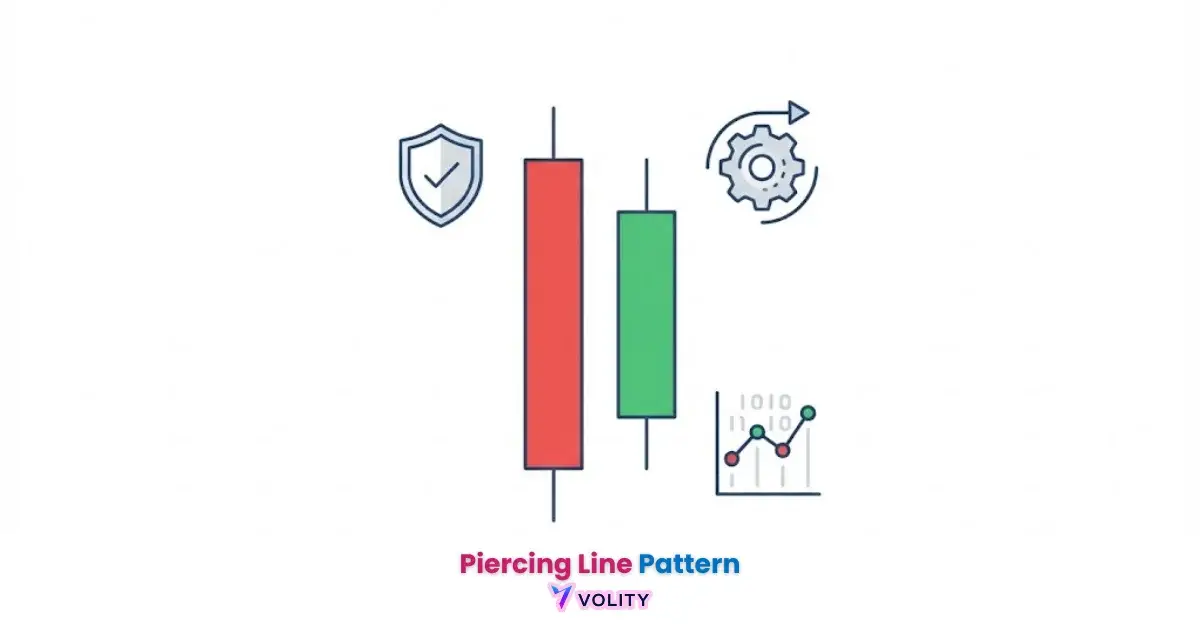
It is characterized by two candlesticks: a long bearish candle followed by a bullish candle that opens with a gap down but closes more than halfway into the real body of the first candle. This pattern indicates a potential shift in market sentiment from bearish to bullish.
Key Characteristics of the Piercing Line Pattern
Identifying the Piercing Line Pattern requires recognizing several key visual cues on a candlestick chart. The pattern consists of two candles: a large bearish candlestick (the first candle) and a bullish candlestick (the second candle). The second candle must open with a gap down below the close of the first candle.
Crucially, the real body of the second candle must close above the midpoint of the first candle’s real body, but not exceed its open. This strong penetration demonstrates significant buying interest. The entire pattern typically appears within an established downtrend, which is essential for its validity as a reversal signal.
Ready to Elevate Your Trading?
You have the information. Now, get the platform. Join thousands of successful traders who use Volity for its powerful tools, fast execution, and dedicated support.
Create Your Account in Under 3 MinutesHow is a piercing line pattern formed?
The piercing line pattern develops over two trading periods, reflecting a significant shift in market dynamics from selling dominance to renewed buying interest. This formation is a key indicator of a potential trend reversal. It begins with a strong bearish move and concludes with a decisive bullish counter-move, challenging the preceding downtrend.
First Candlestick’s Role
The formation of the Piercing Line Pattern begins with the first candlestick, which is typically a long bearish candlestick. This candle has a significant real body, indicating strong selling pressure and confirming the existing downtrend. Its extended length shows that sellers were in firm control, pushing prices lower throughout the trading period.
This initial candle sets the context for the pattern, reflecting the prevailing bearish sentiment before the potential reversal.
Second Candlestick’s Significance
The second candlestick is the pivotal element of the Piercing Line Pattern, signaling a potential bullish reversal. This candle opens with a gap down below the closing price of the first candle, suggesting a continuation of bearish sentiment. However, buyers quickly step in, pushing the price upward to form a bullish candlestick.
Critically, its real body must close above the midpoint of the first candle’s real body, but below its opening price. This strong upward movement, penetrating more than halfway into the preceding bearish candle, indicates a significant shift in power from sellers to buyers.
The penetration signifies that the bullish momentum is strong enough to challenge the prior bearish move.
What does a piercing line pattern indicate?
A piercing line pattern indicates a potential bullish reversal following an established downtrend. This signals that buyers have overcome previous selling pressure, leading to an upward price movement. The pattern reflects a shift in market sentiment, suggesting that the bears are losing control.
Is the Piercing Line Pattern Bullish or Bearish?
The Piercing Line Pattern is definitively a bullish reversal pattern. It appears at the bottom of a downtrend and signals a potential shift from selling pressure to buying pressure. This indicates that the market is likely to move higher after its formation.
The Shift in Market Sentiment
The piercing line pattern reflects a profound shift in market sentiment. Initially, the prevailing downtrend is characterized by strong bearish dominance, as evidenced by the long bearish first candle. However, the second candle, despite opening with a gap down, demonstrates a powerful surge in buying pressure.
This strong bullish push challenges the established bearish control, indicating that buyers are stepping in aggressively and potentially overwhelming sellers. This psychological battle suggests that the market has found a bottom, and the likelihood of a bullish reversal is increasing.
How to Trade the Piercing Line Pattern
Traders must also set clear stop loss and take profit levels to protect capital and secure gains. This comprehensive approach helps mitigate the inherent risks associated with candlestick patterns.
Reliability of the Piercing Line Pattern
The piercing line pattern can be a reliable bullish reversal signal, but its reliability significantly increases with confirmation from other technical indicators. Relying solely on the pattern without additional validation can lead to false signals. Traders should look for supporting evidence to improve confidence in the pattern’s indication.
How to Confirm a Piercing Line Pattern
Confirming a piercing line pattern involves looking for additional signals that validate the potential reversal, significantly increasing its reliability. This can be achieved by using other technical indicators.
Can the Piercing Line Pattern Be Used With Other Indicators?
Yes, the piercing line pattern can and should be used with other indicators to improve its reliability and provide stronger confirmation of a potential bullish reversal. Confirmation from other technical indicators like Volume, RSI, or MACD significantly increases the reliability of a Piercing Line pattern. These tools provide additional layers of analysis beyond just price action.
| Confirmation Indicator | Signal | Purpose |
| Volume | Increased volume on 2nd candle | Stronger buying pressure |
| Support Level | Pattern at key support | Price bounce from floor |
| RSI | Oversold conditions (<30) | Asset undervalued, due for bounce |
| MACD | Bullish crossover | Momentum shift to upside |
| Trendlines | Bounce off trend line | Trend continuation after pullback |
| Timeframe | Higher timeframe pattern | Stronger, more reliable signal |
For instance, a piercing line pattern occurring at a significant support level or accompanied by an increase in volume on the second candle provides stronger conviction. The RSI (Relative Strength Index) can confirm oversold conditions, while the MACD (Moving Average Convergence Divergence) can signal a shift in momentum.
Analyzing the pattern across different timeframes can also improve its validity.
Best Strategies to Trade the Piercing Line Pattern
The best strategies to trade the piercing line pattern involve a systematic approach to entry point, stop loss, and take profit settings, integrated with sound risk management. Effective risk management, including the use of stop-loss orders, is crucial for mitigating potential losses when trading candlestick patterns. This structured approach helps traders maximize potential gains while protecting their capital.
How to Set Stop Loss and Take Profit
- Setting a stop loss and take profit for the piercing line pattern is integral to any robust trading strategy.
- A common stop loss placement is just below the low of the second bullish candle, or even below the low of the first bearish candle, to protect against a failed reversal.
- This ensures that if the market continues its downtrend, losses are minimized.
- For take profit targets, traders often look for the next significant resistance level or use a predefined risk-reward ratio, such as 1:2 or 1:3.
- For example, if your stop loss is 50 pips away, a 1:2 risk-reward ratio would target a 100-pip profit.
- The question of how much capital to risk on a trade identified by a piercing line pattern is crucial here.
- Professional traders generally adhere to the 1-2% rule, risking no more than 1% to 2% of their total trading capital on any single trade.
- This position sizing strategy limits exposure and preserves capital, even if several trades result in losses.
What is the difference between piercing pattern and dark cloud cover?
The Piercing Line Pattern and the Dark Cloud Cover are both two-candlestick reversal patterns, but they signal opposite market sentiments. The Piercing Line indicates a bullish reversal after a downtrend, while the Dark Cloud Cover signals a bearish reversal after an uptrend. Understanding their distinct characteristics is vital for accurate market analysis.
| Characteristic | Piercing Line Pattern | Dark Cloud Cover | Indication |
| Trend Context | End of a downtrend | End of an uptrend | Reversal direction |
| First Candlestick | Long bearish candlestick | Long bullish candlestick | Prevailing trend |
| Second Candlestick | Bullish candlestick | Bearish candlestick | Reversal attempt |
| Opening of 2nd Candle | Gap down | Gap up | Initial market reaction |
| Closing of 2nd Candle | Closes above midpoint of 1st real body | Closes below midpoint of 1st real body | Strength of reversal |
| Overall Signal | Bullish reversal | Bearish reversal | Market direction |
Turn Knowledge into Profit
You've done the reading, now it's time to act. The best way to learn is by doing. Open a free, no-risk demo account and practice your strategy with virtual funds today.
Open a Free Demo AccountFiltering False Signals & Overcoming Psychological Biases
Trading, especially with patterns like the piercing line pattern, extends beyond mere identification; it requires a deep understanding of market context, the ability to filter false signals, and robust psychological discipline. Many traders encounter what looks like a piercing line, only for it to reverse immediately afterward, highlighting the need for advanced filtering techniques.
Combining rigorous backtesting with psychological awareness significantly improves a trader’s success rate with the Piercing Line pattern, minimizing losses from false signals.
Factors Affecting Reliability
The piercing line pattern is considered moderately reliable as a bullish reversal signal. However, its effectiveness is significantly influenced by the market context, the strength of the preceding downtrend, and the presence of additional confirmation indicators. Without these corroborating factors, the pattern can frequently generate false signals, leading to premature entries and potential losses.
Common Mistakes When Trading the Piercing Line Pattern
Common mistakes when trading the piercing line pattern include failing to wait for confirmation, ignoring the preceding downtrend, and neglecting risk management. Many traders also succumb to psychological impact such as fear of missing out or overconfidence. These errors often lead to false signals and unprofitable trades.
Why False Signals Occur and How to Mitigate Them
False signals are a common challenge when trading the piercing line pattern, often leading to frustration and losses. These occur for several reasons, such as a lack of a strong downtrend preceding the pattern, insufficient confirmation from other indicators, or weak penetration of the first candle’s real body by the second.
For instance, if the second candle’s real body only barely crosses the midpoint of the first, the reversal signal is weaker. To mitigate these, always prioritize a clear, established downtrend. Seek additional confirmation from volume, RSI, or support levels. If a piercing line appears but immediately reverses, it often indicates insufficient underlying buying pressure or a stronger bearish trend still at play.
Validating Your Piercing Line Strategy
Backtesting is a crucial step for traders to validate their trading strategy across different timeframes and market conditions. It involves applying your strategy to historical data to see how it would have performed. For the piercing line pattern, backtesting allows you to assess its historical reliability in various markets (e.g., stocks, forex, commodities) and timeframes (e.g., daily, 4-hour, 1-hour charts). This process helps identify optimal entry point and stop loss placements, refine take profit targets, and understand the pattern’s win rate and average risk-reward ratio. By analyzing past performance, traders can build confidence in their strategy and adapt it for future market scenarios, moving beyond generic advice.
Overcoming Psychological Biases
The psychological impact of trading, including emotions like fear, greed, and impulsivity, significantly affects a trader’s success, especially when encountering false signals or losses. Approximately 70-80% of retail traders lose money, often due to poor risk management and emotional trading decisions. A trading journal is an invaluable tool for self-reflection, allowing traders to document their trades, emotions, and decisions. This practice helps identify recurring emotional biases and reinforces disciplined risk management. By understanding and managing these psychological factors, traders can maintain emotional control, stick to their trading strategy, and improve their long-term profitability with patterns like the Piercing Line.
Bottom Line
The Piercing Line Pattern serves as a valuable bullish reversal signal for traders, indicating a potential shift from bearish to bullish market sentiment. Its unique formation, involving a gap down and a strong close above the prior candle’s midpoint, provides a clear visual cue. However, its true power is unlocked through diligent confirmation with other technical indicators and strict adherence to risk management principles. By understanding its nuances and avoiding common pitfalls, traders can effectively integrate this pattern into their strategy to identify and capitalize on potential trend reversals.
Key Takeaways
- The Piercing Line Pattern is a two-candle bullish reversal signal appearing after a downtrend.
- It is characterized by a bearish first candle followed by a bullish second candle that gaps down but closes above the first candle’s midpoint.
- Confirmation with indicators like volume, RSI, or MACD, and identifying support levels, significantly increases its reliability.
- Effective trading involves setting stop losses below the pattern’s low and using risk-reward ratios for take profit targets.
- Filtering false signals and managing psychological biases through backtesting and a trading journal are crucial for success.