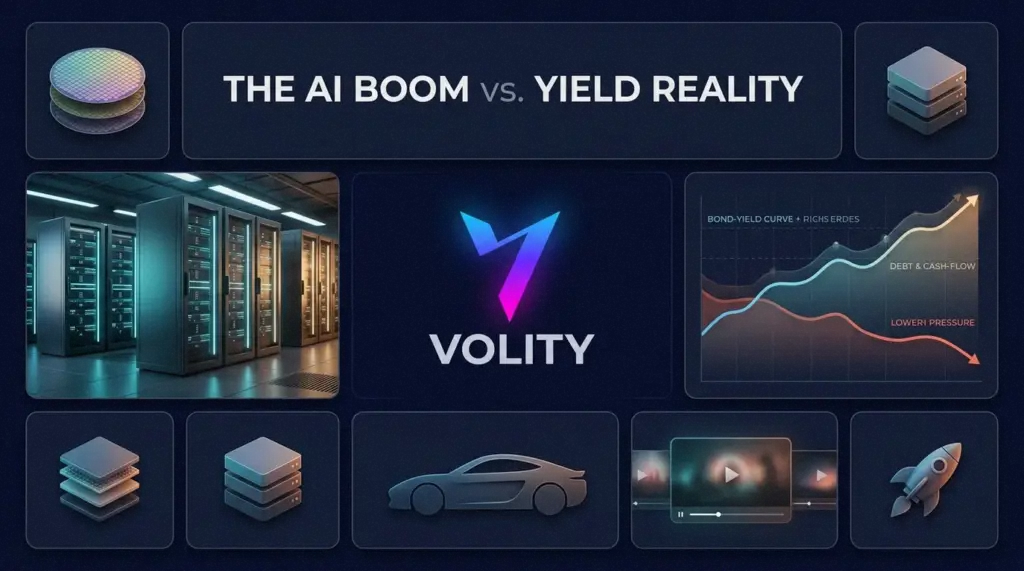
When the AI trade meets its credit test
Wall Street’s latest warning came from the bond market, not an earnings shock or a central-bank surprise.
As borrowing costs rose, investors questioned when AI infrastructure would produce dependable returns.
The Nasdaq sold off sharply before recovering, while Treasuries and defensive shares attracted fresh demand.
Technology’s long-term case remains intact, but investors now want better financing terms.
That shift matters because much of the AI build-out depends on expensive chips, power, land and debt.
Investors once rewarded almost any company attached to data centres. They now want cash flow, utilisation and manageable refinancing.
Micron, SK Hynix, SanDisk, Seagate and Western Digital extended recent declines as investors reassessed the semiconductor boom.
High-bandwidth memory remains essential for AI servers, and demand has not suddenly vanished.
Yet markets are asking whether today’s valuations already capture several years of exceptional growth.
New capacity adds another complication. If supply expands faster than AI spending, memory pricing could weaken quickly.
Chinese competition also clouds the outlook, especially across less specialised parts of the storage market.
For traders, strong industry demand does not prevent painful share-price declines. Crowded positions can unwind before fundamentals actually deteriorate.
Micron’s next results will matter less for headline revenue than for pricing, margins and capital-expenditure plans.
- Watch: HBM pricing, inventory levels and customer order visibility.
- Risk: Capacity plans that outrun sustained data-centre demand.
- Signal: A weaker gross-margin outlook would challenge the strongest semiconductor valuations.
CoreWeave becomes the financing gauge
CoreWeave has become a live stress test for the debt-funded AI infrastructure model.
The company needs steady demand for computing capacity, ready access to capital and high facility utilisation.
Its shares swung sharply during the week, while yields on some bonds reportedly approached 15%.
Those yields do not predict default. They do show investors demanding a steep premium for lending money.
Every percentage point matters when a company funds vast data centres before revenues fully arrive.
Nvidia’s Jensen Huang said CoreWeave’s cost of capital was improving. The bond market has not fully accepted that reassurance.
Bulls need proof that contract demand and pricing can outpace interest costs. Bears need evidence beyond a frightening yield chart.
Until then, CoreWeave may remain the market’s clearest measure of confidence in AI’s leveraged build-out.
Tesla gets a sentiment lift
Tesla shares rose after it unveiled a redesigned Roadster at a SpaceX test site.
The vehicle may use SpaceX-developed propulsion technology, with production targeted for 2028.
The announcement restored Tesla’s familiar blend of engineering theatre and valuation debate.
Still, the Roadster offers little near-term help for deliveries, operating margins or free cash flow.
Production timing, regulatory approval and commercial feasibility remain open questions.
Investors may welcome the headline, particularly after a difficult period for Tesla sentiment. Earnings will eventually pull attention back to volumes and margins.
Netflix confronts a content reset
Netflix fell in premarket trading after Chief Content Officer Bela Bajaria announced her departure.
Former Disney executive Peter Rice is expected to take the role on Oct. 26.
The change arrives after Netflix lost more than 40% of its value since June 2025.
Investors want stronger engagement and a more reliable flow of programmes that become cultural events.
A leadership appointment cannot create a hit series by itself. It can, however, reshape spending priorities and creative decision-making.
Next week’s earnings should offer firmer evidence on subscriber trends, advertising progress and viewing momentum.
Rocket Lab postpones a milestone
Rocket Lab pushed the first launch of its Neutron rocket into 2027, raising the execution stakes.
A delay may avoid a costly failure, but it also postpones revenue and gives rivals extra time.
That trade-off runs through speculative space shares, where valuations often depend on milestones years away.
AST SpaceMobile, Redwire and Intuitive Machines retain compelling long-term opportunities in communications, defence and orbital infrastructure.
But a funding gap, technical problem or delayed launch can overwhelm an attractive narrative in a single session.
Rotation, not a retreat
Markets are not rejecting technology outright. They are demanding stronger balance sheets and clearer returns on investment.
Money has moved from financing-sensitive AI names towards bonds, defensive sectors and selected value shares.
If inflation cools and Treasury yields fall, the rotation could reverse quickly.
If funding remains expensive, weaker business models may face much harsher scrutiny.
- Track bond spreads alongside chip orders and data-centre announcements.
- Check refinancing dates before chasing high-growth infrastructure shares.
- Use earnings guidance to test whether AI spending is producing real operating leverage.
- Treat overbought signals as warnings, not automatic short positions.
The market is not debating whether artificial intelligence has a future. It is deciding who can afford to build it.
Related coverage on Volity
- What Is a P/E Ratio and How to Use It
- Fundamental Analysis in Stock Trading: A Working Definition
- Growth Investing vs Value Investing: Which Style Fits You?
- Fractional Shares Explained: How to Start Investing With $50
- How to Start Stock Trading: A 2026 Beginner Guide
- Dividend Investing for Beginners: How to Start