Crypto’s stress test: hot inflation, institutional custody and a stablecoin sprint
Friday, October 16, 2026. Crypto markets recovered modestly on Friday, yet traders remained guarded after a bruising week.
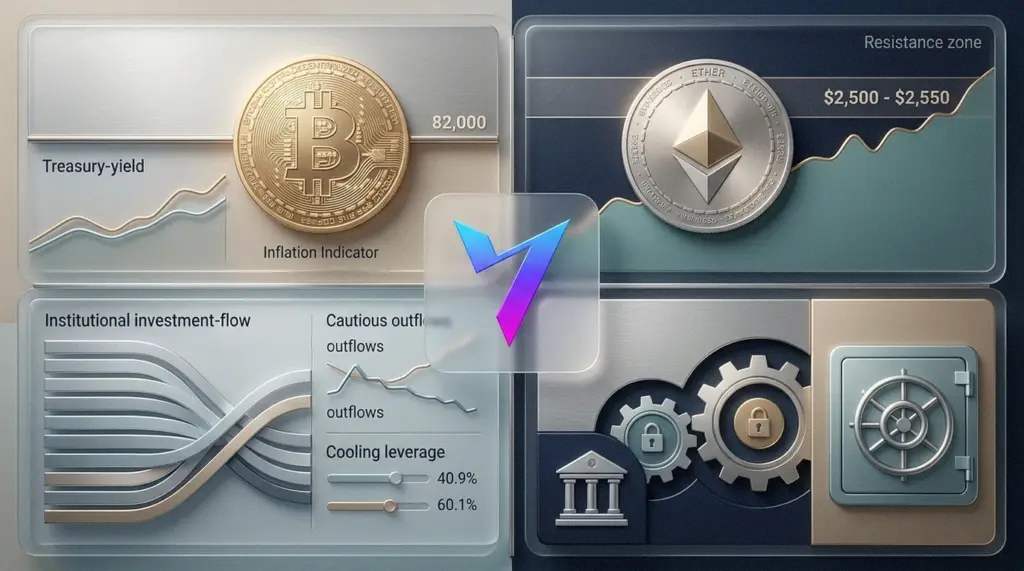
Bitcoin climbed above $82,000 after briefly falling below $80,000. Ether gained more than 4%, approaching $2,460.
Still, the rebound did not erase a hard message from investment flows. Digital-asset products suffered $434 million of weekly withdrawals.
Hotter US inflation and sturdy retail sales changed expectations for interest rates. Risk assets felt the shift almost immediately.
Bitcoin finds support, not conviction
Bitcoin traded between roughly $82,200 and $82,600 during Friday’s session. Lower Treasury yields and softer oil prices aided the recovery.
However, Bitcoin was still heading for a second consecutive weekly decline. October’s usual rally has again failed to arrive.
The $80,000 mark has become the market’s immediate fault line. Traders see it as both a technical support level and a psychological threshold.
A sustained move below that price could invite fresh selling. Buyers, meanwhile, need Bitcoin to reclaim recent resistance with stronger spot demand.
Short-covering can produce sharp rallies, but it rarely builds a lasting trend. Fund flows will matter more than a brief derivatives squeeze.
CoinShares recorded $434 million leaving global digital-asset investment products this week. The withdrawals followed the latest US inflation and spending figures.
Bitcoin’s ability to hold near $82,000 despite those withdrawals deserves attention. Yet it also shows a split market.
Dip buyers remain active at lower levels. Larger institutions, by contrast, appear unwilling to add aggressively before rate expectations settle.
- Bitcoin spot range: roughly $80,000 to $82,600 on Friday.
- Weekly product flows: $434 million of net outflows.
- Immediate support: $80,000.
- Market driver: US yields and shifting Federal Reserve expectations.
Ether tests the upper edge of its rebound
Ether rose from about $2,325 to nearly $2,460, outpacing Bitcoin on the day. The move brought $2,500 back into view.
The $2,500 to $2,550 band now poses the first serious test. Sellers previously appeared around that area.
If Ether clears $2,550, traders will watch $2,600 next. Above that, the $2,750 to $2,800 range returns to the discussion.
A rejection would create a less cheerful map. Prices could retreat towards $2,400, then revisit $2,300 or even $2,200.
Exchange data gives bulls and bears something to argue about. Binance’s Ether reserves fell by roughly 430,000 tokens since late August.
Holdings stood near 3.47 million ETH on October 16. Lower exchange balances can reduce immediately available selling supply.
Yet such figures do not guarantee higher prices. Tokens may move into custody, staking arrangements or other trading venues.
Leverage has also cooled. Binance Ether open interest fell 4.7% over 30 days to about $6.1 billion.
That decline makes the rebound less frothy than previous bursts. It also suggests traders have not fully restored their appetite for risk.
During the inflation-led sell-off, Binance reportedly liquidated about $106 million in Ether long positions. Macro data still moves crypto derivatives with startling speed.
Deutsche Bank edges into custody
Traditional finance supplied Friday’s more durable news. Deutsche Bank said its first digital-asset service is weeks from launch.
Germany will receive the initial rollout. The bank plans to begin by holding Bitcoin and Ether for clients.
It also intends to support transfers into and out of major stablecoins. The proposed list includes USDC, EURC and EURAU.
The lender has not named a launch date or a first live customer. Regulatory completion and technical readiness still determine the timetable.
That distinction matters for investors. A custody service does not create an exchange, a liquid market or instant client demand.
Still, the direction is clear. Large banks increasingly see digital assets as settlement and safekeeping infrastructure, rather than a retail trading novelty.
Deutsche Bank expects to extend the service into Asian financial centres next year. It is also preparing work around tokenised deposits and digital bonds.
For institutions, familiar controls may matter more than token speculation. Custody, compliance and settlement sit closer to bank revenue models than meme coins ever did.
Stablecoins race towards ordinary payments
Stablecoins are becoming the industry’s busiest bridge to conventional finance. Circle’s USDC received a significant e-money token classification under MiCA.
The designation brings direct European Banking Authority supervision from November 12. It also gives USDC a clearer position in a tightly regulated market.
Circle plans to enter 40 additional markets. Visa and Mastercard, meanwhile, are building rails between stablecoins and traditional currencies.
The competition increasingly centres on distribution. Merchants and corporate treasurers care about settlement speed, costs and compliance.
They rarely care about loud token launches. The eventual winners may make stablecoins almost invisible to the people using them.
Ripple is pursuing that route for RLUSD through Cross River. The objective is to place the token within core banking operations.
Tether has backed Saber Money, which is targeting growth across Asia and the Gulf. These strategies point towards a payments contest, not merely a crypto contest.
Regulators close the informal exits
Regulators continue to tighten the perimeter around unregulated crypto activity. Russia plans to ban direct peer-to-peer crypto trading from July 2027.
The proposed rules would redirect activity into regulated channels. Australia will begin sharing crypto-tax information internationally by 2028.
In the United States, a federal judge refused to cancel Gemini’s $5 million penalty. The decision came despite the CFTC changing its stance.
Enforcement risk remains real when agencies revise their interpretations. Exchanges cannot assume later policy shifts will erase earlier liabilities.
Taiwan has also blocked Coinbase and Kalshi over election-betting concerns. Elsewhere, an automated Ethereum agent exposed wallet-permission risks.
Software mistakes become financial mistakes when an agent can move tokens. That risk will grow as automated trading tools gain wider access.
Levels for the week ahead
- Bitcoin: $80,000 remains the level to defend after a second weak week.
- Ether: $2,550 is the breakout level, while $2,400 offers first support.
- Flows: renewed inflows would give any rally greater credibility.
- Macro: Treasury yields remain crypto’s fastest link to US economic data.
Friday’s green candles offered relief, not resolution. Tighter financial conditions are draining speculative money from the market.
At the same time, banks, payment networks and regulators are building more durable rails. Crypto now faces a more demanding question.
Markets are deciding which tokens remain speculative instruments. They are also deciding which ones become part of ordinary financial plumbing.
Related coverage on Volity
- How to Avoid Crypto Scams: A Beginner Safety Checklist
- How to Choose a Trading Platform: A 10-Point Checklist
- Demo vs Live Trading Account: A 7-Step Checklist Before You Go Live
- How to Size a Trade: Position Sizing and Risk Per Trade for Beginners
- Risk-Reward Ratio Explained: How to Set It and Why It Matters
- ETF vs Index Fund: The Difference and Which to Pick