Markets split between AI heat and yield hunting
Risk appetite remains constructive, but it is no longer plain vanilla.
U.S. equity futures and the large index trackers are firm, with SPY, QQQ and DIA all positive on the main trading board. Meanwhile, TLT, GLD and Bitcoin are also holding gains. That mix tells a useful story. Traders are still willing to chase growth, yet they are keeping one hand near the hedge book.
In other words, the tape is risk-on, but not carefree. AI remains the loudest theme. However, income trades, regulatory events and overbought energy charts are all competing for attention. For active accounts, the day is less about one grand macro call. It is about matching each trade to the right type of risk.
AI names still lead, but valuation now bites
Nvidia (NVDA) remains the market’s AI centre of gravity. Yet the discussion is shifting. Traders are no longer looking only at chip demand and gross margins. They are also watching Nvidia’s ability to finance, anchor and shape the broader AI ecosystem.
Reports around OpenAI-linked financing talks have fed that view. If Nvidia can use its balance sheet to secure strategic partners, it may deepen its advantage beyond silicon. Still, the stock is not trading like a cheap cyclical. It remains a long-term moat trade, not a simple earnings pop.
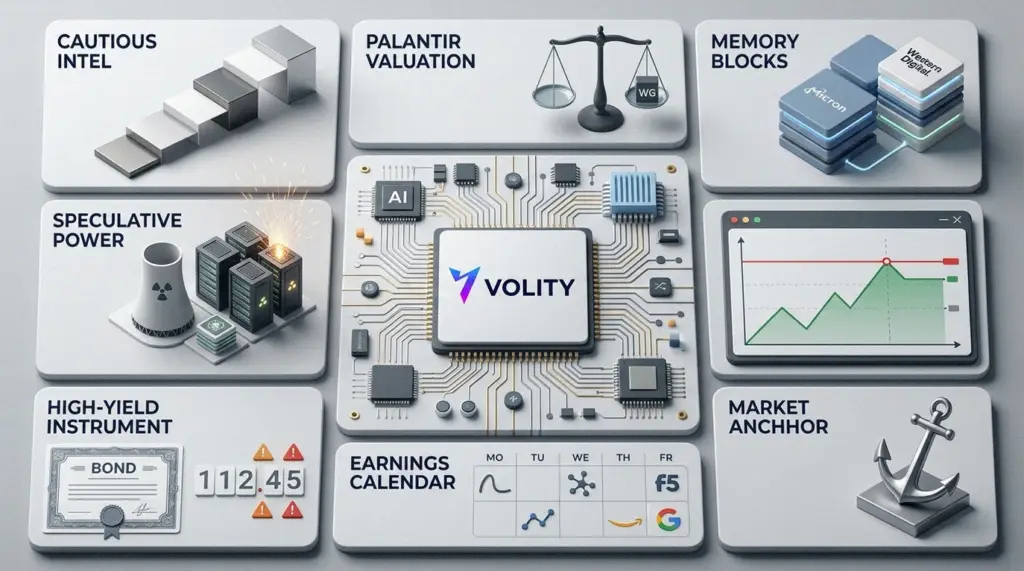
Intel (INTC), meanwhile, has returned to the speculative turnaround list. A more aggressive analyst case suggests earnings could potentially quadruple over four years. The bull case rests on AI server chips, foundry growth and better execution. However, traders are not paying for that full story yet.
That caution is rational. Intel must prove it quarter by quarter. The stock remains a “show me” trade, even with a more interesting upside case than it had a year ago.
Palantir (PLTR) is still one of the most divisive AI stocks on the screen. Growth investors like the revenue trajectory and government-commercial mix. However, valuation-sensitive funds keep pushing back. The stock needs guidance to stay hot, because the multiple already assumes a lot of success.
Memory chips are also moving back into focus. Micron (MU) and Western Digital (WDC) face fresh attention as China accelerates its DRAM and NAND ambitions. Western Digital, which owns the SanDisk brand, has already enjoyed a strong run. Any sign that Chinese suppliers are closing the technology gap could pressure margins.
Apple (AAPL) sits just outside that fight, but not far away. As a major buyer of memory and storage, it has supply-chain exposure. So, even peripheral headlines can matter if component pricing starts to move.
Nuclear power trades get a data-centre spark
The nuclear plus AI power theme has moved from message-board curiosity into active trading territory.
Oklo (OKLO) has drawn speculative flows as investors revisit nuclear demand tied to AI data centres. The argument is simple enough. Data centres need reliable power, and the AI build-out is making that requirement harder to ignore.
Nano Nuclear Energy (NNE) has also been trending after attention on an Air Force SBIR contract linked to its KRONOS microreactor project. The defence angle gives the story an extra charge. However, these names still trade more on narrative than current fundamentals.
For traders, that distinction matters. The theme may be real, while the stocks remain highly sensitive to headlines, liquidity and positioning. They belong in the speculative bullish bucket, not the core infrastructure sleeve.
Earnings and event risk crowd the tape
The calendar is busy, and several stocks carry single-headline risk.
Coca-Cola (KO) heads into its Q2 report with estimates around $0.93 in EPS and $13.17 billion in revenue. The dividend yield sits near 2.6%, which keeps the stock in the defensive-income camp. However, investors still need proof that pricing power and volumes can hold up together.
F5 (FFIV) faces a more delicate setup. Expectations sit near $4.00 in EPS and roughly $833 million in revenue. Yet the recent cybersecurity breach means traders may care more about management’s tone than the headline beat. Any vague answer on security or demand could weigh on the stock.
Amazon (AMZN) and Alphabet (GOOGL) remain central to the broader tape. Cloud growth, AI spending and advertising trends can all move index sentiment quickly. Even investors who do not trade the shares directly should keep them on the desk blotter.
Hut 8 (HUT) adds crypto beta to the earnings calendar. The stock trades roughly 65% above its 200-day moving average, which confirms strong longer-term momentum. However, that same stretch raises the odds of sharp swings around Bitcoin and guidance.
Capricor Therapeutics (CAPR) is the cleaner event-risk outlier. Shares fell sharply after FDA briefing documents arrived ahead of a July 29 advisory committee meeting. Analysts may still like the longer-term case. Near term, though, the committee vote is likely to dictate the chart.
Energy charts flash hot, not broken
Several energy-linked names now show classic overbought readings.
- Oceaneering International (OII)
- WKC
- Plains All American Pipeline (PAA)
Each has registered RSI readings above 70 on standard technical screens. That does not automatically create a short. Strong stocks can stay overbought longer than tired traders can stay patient.
Still, the signal is useful. After a fast run, profit-taking becomes easier to trigger. Meanwhile, weaker oil, firmer rates or a broad risk wobble could turn a tidy rally into a pullback. Traders watching these names should think in levels, not feelings.
High yield still attracts buyers, with strings attached
Income remains a large part of the market’s personality. With policy rates still elevated, investors continue to hunt for cash flow. However, double-digit yields in financials are not free money.
Ellington Financial (EFC) offers an annual dividend yield around 11% to 12%, supported by mortgage and credit strategies. Analysts broadly remain positive. Yet the trade carries exposure to funding costs, asset marks and credit conditions.
Starwood Property Trust (STWD) brings scale to the income screen. The commercial and infrastructure lender has total assets above $60 billion and continues to deploy capital into new loans. However, its size does not remove rate sensitivity. It simply makes the moving parts more important.
Western Union (WU) rounds out the yield list. The payout looks attractive, but the business faces pressure from digital competition and slower growth. Investors need to treat the yield as payment for risk, not as a comfort blanket.
By the numbers
- $0.93 – expected Q2 EPS for Coca-Cola.
- $13.17 billion – expected Coca-Cola quarterly revenue.
- $4.00 – expected EPS for F5.
- 65% – Hut 8’s approximate premium to its 200-day moving average.
- 70+ – RSI zone now visible in several energy names.
Mega-cap board stays crowded
The market’s liquidity core remains concentrated in AAPL, MSFT, NVDA, GOOGL, META, TSLA, AMZN and IBM. These stocks still serve several jobs at once. Traders use them for direction, hedges and fast pivots when macro headlines hit.
With earnings season and central-bank commentary overlapping, intraday volatility should remain elevated. Meanwhile, the split between AI momentum, defensive income and event risk keeps the tape lively. The best opportunities may come from knowing which game each ticker is actually playing.
Related coverage on Volity
- What Is a P/E Ratio and How to Use It
- Fundamental Analysis in Stock Trading: A Working Definition
- Growth Investing vs Value Investing: Which Style Fits You?
- Fractional Shares Explained: How to Start Investing With $50
- How to Start Stock Trading: A 2026 Beginner Guide
- Dividend Investing for Beginners: How to Start