Wall Street’s watchlist: quantum momentum, earnings tests and a PMI trap
NEW YORK, September 23, 2026 – Wednesday’s market opened with no shortage of stories and little certainty.
IonQ offered a tangible technology catalyst. Meanwhile, General Mills, KB Home and AutoZone faced sharply different earnings tests.
At 9:45 a.m. Eastern time, preliminary U.S. purchasing managers’ data could reshape the morning’s tone. Treasury yields, the dollar and megacap technology shares all stood exposed.
The sensible approach was conditional. Traders needed confirmation from price, volume and market reaction rather than compelling headlines alone.
IonQ faces the opening-range test
IonQ said it had tested an end-to-end quantum error decoder on a standard central-processing unit.
The company said simulations involved up to 408 logical qubits and more than 31.5 million quantum operations.
Separately, IonQ’s Superion 256 system is due at Nvidia’s Accelerated Quantum Research Center next year.
The machine will connect to Nvidia’s GB200 NVL72 architecture through NVQLink. Nvidia’s CUDA-Q platform will manage the workloads.
That combination pushed IonQ shares nearly 11% higher in premarket trading. However, a large opening gap can become a trap.
Early buyers often rush in after a technical announcement. The opening range therefore mattered more than the press release’s language.
A sustained move above that range, with strong volume, would suggest institutional demand. Equally, a quick loss of VWAP would weaken the bullish case.
Rigetti Computing rose alongside the quantum group. Yet it needed its own volume and relative strength to justify follow-through.
Sympathy rallies can fade quickly when traders discover no separate catalyst. Rigetti remained the weaker version of the same idea.
Earnings need more than a headline beat
General Mills was scheduled to report fiscal first-quarter figures before the opening bell.
Consensus forecasts centred on earnings near 72 cents a share. Revenue estimates sat between $4.34 billion and $4.35 billion.
However, packaged-food investors rarely stop at the headline numbers. They will scrutinise organic sales, volume, pricing and gross margins.
Input costs and full-year guidance may matter even more. A revenue beat would mean little if consumers reduced purchases.
Likewise, declining shipment volumes could overshadow better pricing. General Mills needed to show that its brands still held pricing power.
KB Home brought a familiar housing-market complication. Its earnings beat did not settle concerns about new demand and future profitability.
Investors were likely to focus on net orders, cancellations, incentives, backlog and homebuilding margins. In particular, incentives could reveal how hard builders must work for sales.
A company can beat quarterly estimates through timing or cost control. Yet a soft order book can signal trouble several quarters ahead.
KB Home therefore needed stronger orders and stable margins to support a durable advance. Anything less left the shares neutral to cautious.
AutoZone supplied the day’s messiest earnings picture. The company earned $56.05 a share, while revenue of roughly $6.59 billion missed expectations.
Tariff refunds and a non-cash LIFO benefit helped reported profitability. Meanwhile, early-quarter sales appeared softer than the earnings number suggested.
That made the quality of the beat the central issue. Same-store sales, commercial demand and sustainable gross margins mattered most.
Investors should resist treating every earnings beat as bullish. In AutoZone’s case, the top-line miss complicated the apparently strong profit result.
PMI could reset the market’s tone
September’s preliminary PMI data arrived at 9:45 a.m. Eastern time. Estimates called for a 53.6 manufacturing reading, 56 for services and 55.2 for the composite.
A reading above 50 signals expansion. Still, the market response mattered more than the decimal point.
Stronger activity and rising Treasury yields could favour cyclical shares. However, that mix could pressure expensive technology stocks and long-duration assets.
Weak data alongside falling yields could lift growth shares, especially in the Nasdaq. Yet it could also revive worries about slowing economic momentum.
The most favourable combination for equities would be solid activity with declining yields. Conversely, weak activity and rising yields would trouble nearly every risk asset.
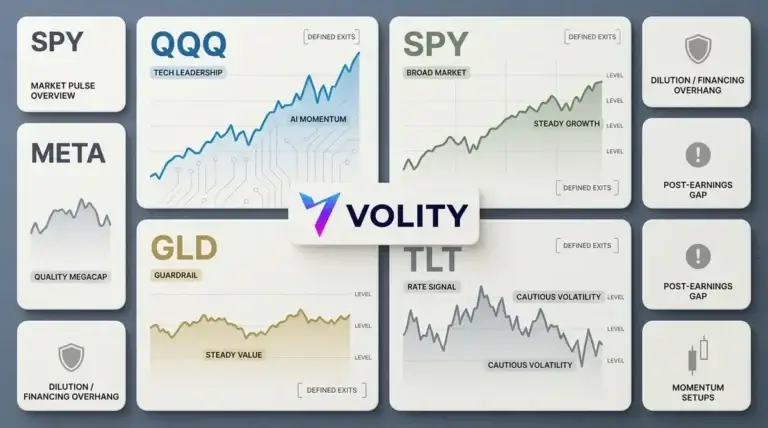
- SPY: Watch market breadth after the PMI release.
- QQQ: Watch whether higher yields pressure large technology shares.
- TLT: Look for a sustained yield decline, not a brief headline move.
- GLD: Follow real yields and the dollar before following gold’s first reaction.
The dollar offered another useful clue. A stronger dollar with rising yields would signal tighter financial conditions.
By contrast, falling yields and a softer dollar could give risk assets room to recover. Traders needed to watch the full market, not merely the PMI screen.
Watchlists require restraint
A reported UBS Buy rating and $120 target could support sentiment around CoreWeave. An analyst target is still not a trading level.
The AI-computing group still faced customer concentration, capital-spending, leverage and debt-servicing risks. Without a current reference price, claimed percentage upside remained imprecise.
Meta Platforms had a credible long-term artificial-intelligence case. However, interest in its Muse AI work did not create a clear short-term catalyst.
Investors needed evidence from advertising, engagement, operating costs and capital-expenditure guidance. Product excitement alone cannot settle valuation debates.
Smaller names demanded greater care. Aduro Clean Technologies needed scalable pilot economics, while Oruka Therapeutics needed fuller clinical disclosure.
BullFrog AI’s insider buying required context on dilution and cash runway. Similarly, Vistagen’s preliminary Phase 3 data needed complete endpoint and regulatory detail.
These shares may move sharply. That volatility, however, is a reason for tighter risk controls rather than looser ones.
Finally, an overbought RSI in Deere, Vicor or Worthington Enterprises was a warning, not a short-sale command.
Momentum can stay stretched for longer than sceptics expect. Instead, traders should seek failed breakouts, bearish divergences, VWAP losses or broken support.
Key trading implications
- IONQ: The strongest catalyst, but only if price holds its opening range and VWAP.
- GIS: Focus on volumes, pricing and guidance after the fiscal first-quarter release.
- KBH: New orders and incentives carry more weight than headline earnings.
- AZO: Treat the profit beat cautiously after the revenue miss and one-off benefits.
- SPY, QQQ and TLT: Let yields, breadth and the dollar interpret the PMI data.
Wednesday’s best ideas came with conditions attached. IonQ had momentum, while the PMI offered a broad-market test.
The remaining names deserved attention, certainly. They did not yet deserve an automatic buy button.
Related coverage on Volity
- What Is a P/E Ratio and How to Use It
- Fundamental Analysis in Stock Trading: A Working Definition
- Growth Investing vs Value Investing: Which Style Fits You?
- Fractional Shares Explained: How to Start Investing With $50
- How to Start Stock Trading: A 2026 Beginner Guide
- Dividend Investing for Beginners: How to Start