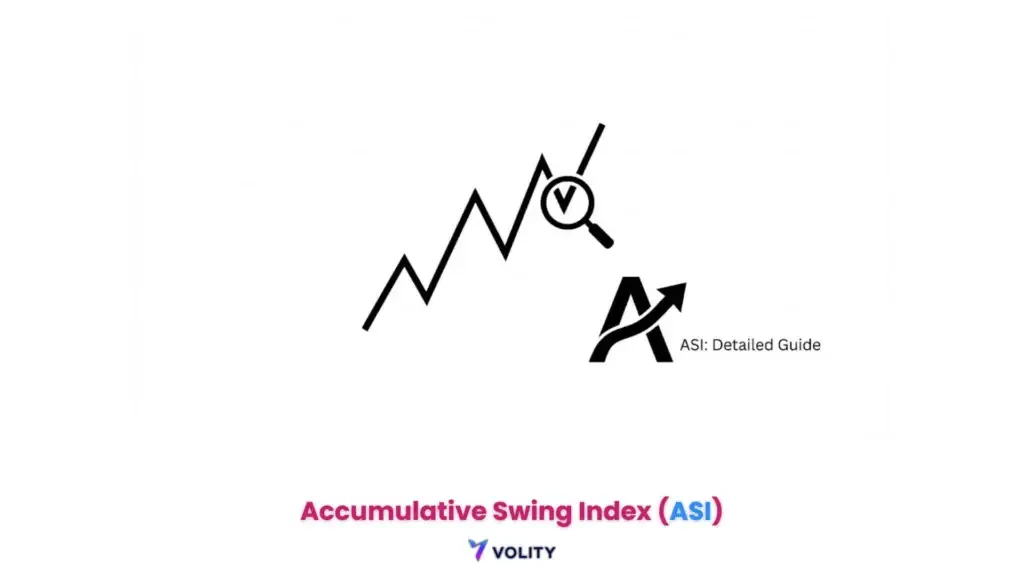
The Accumulative Swing Index (ASI) is J. Welles Wilder’s “true trend” indicator. it filters market noise by measuring the strength of price swings using the open, high, low, and close. Traders use ASI to confirm trends, spot divergences with price, and avoid false breakouts in choppy markets. The Limit Move setting controls how aggressively the indicator filters noise.
Trading CFDs, forex, and leveraged financial instruments carries a high level of risk. The Accumulative Swing Index is a technical tool to support trend analysis, not a guarantee of market direction. Price gaps, market gaps, and gaps from exchange-mandated Limit Move changes can create divergences between the indicator and price action. Past performance is not indicative of future results. Capital at risk.
The Accumulative Swing Index (ASI) is an unbounded technical indicator developed by J. Welles Wilder Jr. to reveal the “true” underlying market trend. It factors in open, high, low, and closing prices while adjusting for gaps through a Limit Move constant. ASI reveals directional bias by filtering insignificant daily price noise.
The Accumulative Swing Index (ASI) measures the genuine underlying trend of a financial asset by filtering out daily market noise. J. Welles Wilder Jr. introduced this unbounded index in his 1978 book to provide a more accurate depiction of price movement than simple closing prices. The indicator identifies significant shifts in sentiment by comparing current price action to the previous session’s close.
The ASI is not one of the indicators MetaTrader ships by default; on both MetaTrader and TradingView it is added as a custom or community indicator. It is particularly effective for traders who require high-conviction signals for trend following or reversal identification. By accounting for the relationship between opens, highs, lows, and closes, the ASI offers a comprehensive view of market strength.
While understanding Accumulative Swing Index (ASI) is important, applying that knowledge is where the real growth happens. Create Your Free Forex Trading Account to practice with a free demo account and put your strategy to the test.
What is the primary purpose of the Accumulative Swing Index (ASI)?
The Accumulative Swing Index (ASI) is a trend-following technical indicator that aims to reveal the true directional force of a market by filtering out insignificant daily fluctuations. First published in 1978 by J. Welles Wilder Jr., the ASI separates meaningful price movement from daily market noise. The indicator compares current price relationships against previous sessions to identify the direction and magnitude of underlying trend strength.
The Swing Index (SI) forms the calculation foundation for the ASI. Unlike raw price charts where daily gaps and opening jumps distort the true trend, the SI measures only the substantive price relationship, comparing the current day’s range and close to the prior day’s close. This creates a normalized value that accumulates over time, producing the continuous trend line that defines the ASI.
J. Welles Wilder Jr.’s Technical Legacy
J. Welles Wilder Jr. is the pioneer of modern technical analysis who developed the ASI alongside the RSI and ADX. Wilder’s overarching goal was to identify what he termed the “true price” of a market, not the closing price or opening gap, but the accumulated sentiment expressed through the relationship between opens, highs, lows, and closes. His 1978 work fundamentally changed how traders quantify trend strength and identify reversals.
Ready to Elevate Your Trading?
You have the information. Now, get the platform. Join thousands of successful traders who use Volity for its powerful tools, fast execution, and dedicated support.
Create Your Account in Under 3 MinutesHow is the Accumulative Swing Index (ASI) calculated?
The Accumulative Swing Index (ASI) calculation involves a running total of the daily Swing Index (SI), which factors in the current day’s open, high, low, and close against the prior day’s close. The SI itself measures the relationship between the current bar’s range and where the market closed relative to the prior day. True Range captures volatility and adjusts for price gaps that would otherwise distort the calculation.
The R factor is fixed by the largest of the three price relationships in a single session, as Wilder defined it in New Concepts in Technical Trading Systems (1978). This normalized approach ensures that the ASI produces comparable values across different asset classes and volatility regimes. For example, a 50-pip move in EURUSD has proportionally different weight than a $50 move in crude oil, the R Factor accounts for these differences.
Understanding the Limit Move (R Factor)
The Limit Move is a user-defined constant that represents the maximum allowable daily price change on an exchange. Some agricultural and rate futures carry a published daily limit, and where one exists you use it. In markets with no such limit, including forex and crypto, traders set the constant high, conventionally 10,000, so it stops distorting the calculation rather than driving it.
Setting the Limit Move value incorrectly creates serious problems. If the constant is too low on forex pairs, the ASI line becomes flattened and fails to capture real trend moves. If too high, the indicator becomes overly sensitive to single-session gaps. Platform defaults (MetaTrader, TradingView) typically set this to 10,000 for non-limited markets, which is the correct starting point.
How to trade divergence with the Accumulative Swing Index (ASI)?
Trading divergence with the Accumulative Swing Index (ASI) identifies potential market reversals by highlighting discrepancies between price action and the indicator’s trend line. Bullish divergence occurs when price reaches a lower low but the ASI fails to break its prior low, signaling that selling pressure is weakening even as price declines. Bearish divergence occurs when price reaches a higher high but the ASI cannot surpass its previous peak, indicating that buying pressure is insufficient to sustain the move.
Divergence signals are most powerful on daily timeframes where Wilder designed the ASI specifically to filter noise. A Gold trader observing price at a double top while the ASI shows a lower high receives a clear warning: the buyers who sustained the first peak are no longer present. It is a warning that the move is running on fewer participants, not a measurement of how far the correction runs.
Worked illustration: price prints a double top while the ASI fails to take out its own prior peak. The second push is being made by fewer participants than the first, which is the whole content of the signal. What happens next is a matter for your stop, not for the indicator. Past performance is not indicative of future results.
The average true range (ATR) and market reversal signals often validate divergence setups by confirming that volatility is also contracting, a sign of trend exhaustion. Traders combine ASI divergence with these additional confirmations to increase conviction before entering contrarian positions.
Is the Accumulative Swing Index (ASI) a leading or lagging indicator?
The Accumulative Swing Index (ASI) acts as a leading indicator of trend confirmation by frequently breaking its own swing points before price does. When the ASI breaks above its prior swing high before price does, that ordering is the signal traders act on. This leading characteristic makes the ASI powerful for anticipating breakouts before the bulk of retail traders recognize them.
The ASI leads price because it measures the accumulation of true price relationships, not just closing prices. A divergence or swing point break in the ASI reveals a shift in the underlying order flow before that shift becomes visible in raw price action. On sideways or choppy markets, however, the ASI’s leading nature can generate false breakout signals as price oscillates within a wide range without clear directional intent.
Using ASI to validate technical indicators for trading creates a layered confirmation system. When the ASI breaks a swing high AND the relative strength index (RSI) crosses above 50 AND price breaks a key resistance level, the probability of a sustained move increases dramatically. This multi-indicator approach reduces false signals that arise from any single indicator read in isolation.
Turn Knowledge into Profit
You have done the reading, now it is time to act. The best way to learn is by doing. Open a free, no-risk demo account and practice your strategy with virtual funds today.
Open a Free Demo AccountASI vs. RSI: How do these Wilder indicators differ?
The Accumulative Swing Index (ASI) tracks accumulated trend direction while the Relative Strength Index (RSI) measures momentum speed within a fixed range. Both were created by J. Welles Wilder Jr., but they answer different questions: ASI asks “what is the trend direction and strength?”, while RSI asks “is momentum expanding or contracting within that trend?”
| Indicator | Property | Specification |
| ASI | Range | Unbounded (Accumulative) |
| RSI | Range | 0 to 100 (Oscillator) |
| ASI | Best Use | Trend Confirmation / Breakouts |
| RSI | Best Use | Overbought / Oversold / Momentum |
| ASI | Data Inputs | Open, High, Low, Close, Prior Close |
| RSI | Data Inputs | Average Gains vs. Average Losses |
Source: J. Welles Wilder Jr., New Concepts in Technical Trading Systems (1978), which introduced both indicators. See also Wilder’s Wikipedia entry.
What are the best settings for the Accumulative Swing Index (ASI)?
Optimal settings for the Accumulative Swing Index (ASI) depend on the asset class and its inherent daily price limits. The Limit Move constant is the critical setting that determines how the ASI normalizes volatility across different markets. Forex pairs typically use 10,000, futures with a published daily limit use that limit, and cryptocurrency uses 10,000 to accommodate daily swings.
The Daily (D1) and Weekly (W1) timeframes are superior for ASI because they provide sufficient bar data to smooth out intraday noise that creates false signals. Hourly and 4-hour timeframes show excessive whipsaw and divergence noise on the ASI because Wilder designed the indicator to work on daily settlement cycles. Many traders set the ASI indicator with a 14-period moving average overlay to further smooth the line on longer timeframes.
Using ASI with support and resistance levels and risk management strategies creates a complete system. When the ASI breaks above resistance AND price approaches a key support level simultaneously, the probability of a bounce increases, allowing traders to size positions appropriately using technical indicators for trading as part of a broader strategy.
A custom MetaTrader implementation exposes both the Limit Move and the averaging period, and the TradingView community versions offer the same two controls. Backtesting different Limit Move values on your preferred asset class is the only way to find the setting that behaves sensibly on that instrument; there is no published lead time the indicator delivers reliably.
Key Takeaways
- The Accumulative Swing Index (ASI) identifies the true underlying trend by filtering out insignificant daily price noise.
- The Accumulative Swing Index calculation was introduced by J. Welles Wilder Jr. in 1978 to improve upon simple price charts.
- The Accumulative Swing Index uses a “Limit Move” factor to adjust for gaps and normalize volatility across different asset classes.
- The Accumulative Swing Index frequently serves as a leading indicator of breakouts by breaching its own swing highs before price.
- The Accumulative Swing Index generates powerful reversal signals through bullish and bearish divergence with price action.
- The Accumulative Swing Index is most effective when combined with risk management strategies and higher timeframe analysis.
Where to Go From Here
The ASI is most effective when paired with other indicators. The Aroon indicator confirms trend strength alongside ASI swing filters. The golden cross / death cross works as a long-term confirmation when ASI signals an entry. The single candlestick patterns guide covers the bar-level reads that drive ASI calculation.
Wilder pioneered ASI in his 1978 book New Concepts in Technical Trading Systems, the same book that introduced RSI and ATR. see our complete forex trading books reading list for the original sources. The traders who built systems on Wilder’s indicators are profiled in our 15 most successful forex traders deep dive. To run ASI on a regulated platform, see our review of the best forex trading platforms in 2026.
Frequently Asked Questions
This article contains references to the Accumulative Swing Index (ASI) and Volity, a regulated CFD trading platform. This content is produced for educational purposes only and does not constitute financial advice or a recommendation to buy or sell any financial instrument. Always verify current regulatory status and platform details before using any trading service. Some links in this article may be affiliate links.
What our analysts watch: Three lenses make ASI tradeable. Trend confirmation comes first: the ASI line should slope in the same direction as price; a flat or counter-sloping ASI inside a price trend is the early warning. Pivot breaks matter: ASI breaking its own previous swing high or low frequently leads price by one to three sessions, which is why trend traders watch the indicator for early entry. Divergence is the third signal: price making new highs while ASI fails to confirm is the classic sign of weakening trend. The Limit Move setting (10,000 in unrestricted markets like FX and crypto) keeps the calculation behaving across asset classes.
Accumulative Swing Index follow-up questions
How is ASI different from RSI?
RSI is a momentum oscillator bounded between 0 and 100, designed to read overbought and oversold conditions inside a fixed window. ASI is an unbounded cumulative trend indicator: there is no overbought line, only the question of whether the line is sloping with price and confirming swings. They answer different questions and work well together. Wilder introduced both in the same 1978 book.
What Limit Move setting should I use?
For markets with daily price limits (some agricultural and rate futures) use the published exchange limit. For unrestricted markets (FX, indices, crypto) Wilder recommended a high default such as 10,000 to normalise the calculation. Each exchange publishes the limit conventions for its own contracts, so read the contract specification rather than a general reference.
Does ASI work in crypto markets?
ASI applies to any market with open, high, low, close data. It works best on daily and four-hour timeframes in instruments with sufficient liquidity. Below the one-hour level, noise dominates the swing calculations and the indicator becomes erratic. Wikipedia’s technical analysis article covers how indicator behaviour changes with the liquidity of the instrument.
Can I add ASI to my Volity charts?
The CFD instruments accessible through a Volity account, regulated via CySEC 186/12 (UBK Markets) with Saint Lucia and Cyprus entities, support standard technical indicators. ASI is an indicator inside a sized, journaled process; the durable edge sits in the process, not in any single line.
Volity operates a trading platform and also publishes educational and analytical content about trading. The content on this page is for educational purposes only and should not be considered financial advice. Volity may benefit commercially when readers open trading accounts through links on this site.
Our content is produced and reviewed under documented editorial standards; see our comparison and review methodology.