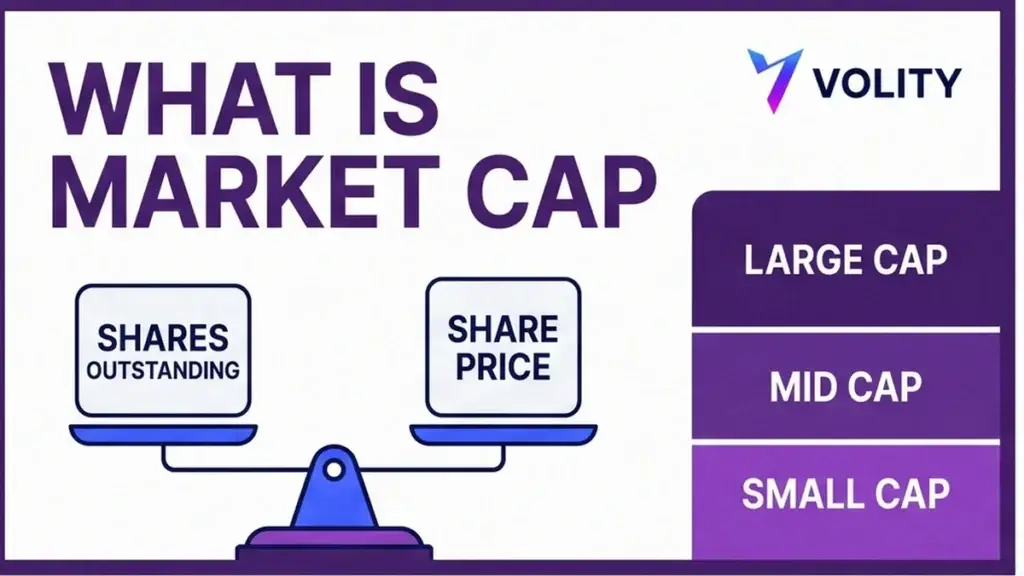
Ask what a company is “worth” on the market and the first number anyone reaches for is its market cap. So what is market cap? It is the total value the market puts on every share at once, and the fastest way to size a business before you read a line of its accounts. This guide gives you the one-sentence version, the formula, a worked example, and the limits nobody mentions when they quote the figure.
TL;DR / Quick insight: Market cap, short for market capitalisation, is a company’s share price multiplied by its total number of shares. It tells you the market’s price tag for the whole business in one number. Use it to sort companies into large, mid and small bands and to gauge size, not to judge whether a share is cheap or dear. On Volity you can act on it with real shares and fractional shares in one commission-free account.
Nothing here is personal advice – investing carries risk, and a big number alone never makes a share a buy.
Market cap in one sentence
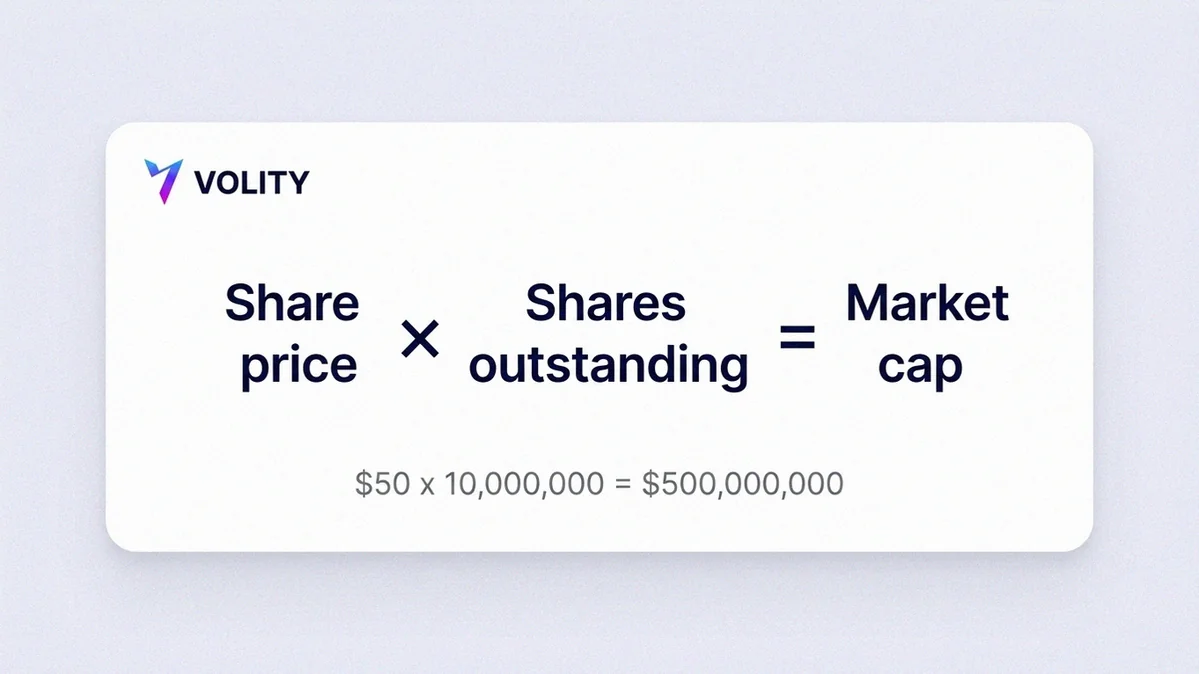
Market cap is what it would cost, in theory, to buy every share at today’s price: one number for the whole business, priced by the market right now.
That is why people lean on it. You cannot compare two companies by share price alone, because price depends on how many shares exist. A low-priced share can belong to a far larger company than a high-priced one if it has issued many more shares. Market cap folds price and share count into one figure, so very different businesses line up by value.
Think of it as the market’s price tag for the whole company. It moves whenever the price moves, and says nothing yet about whether that tag is fair.
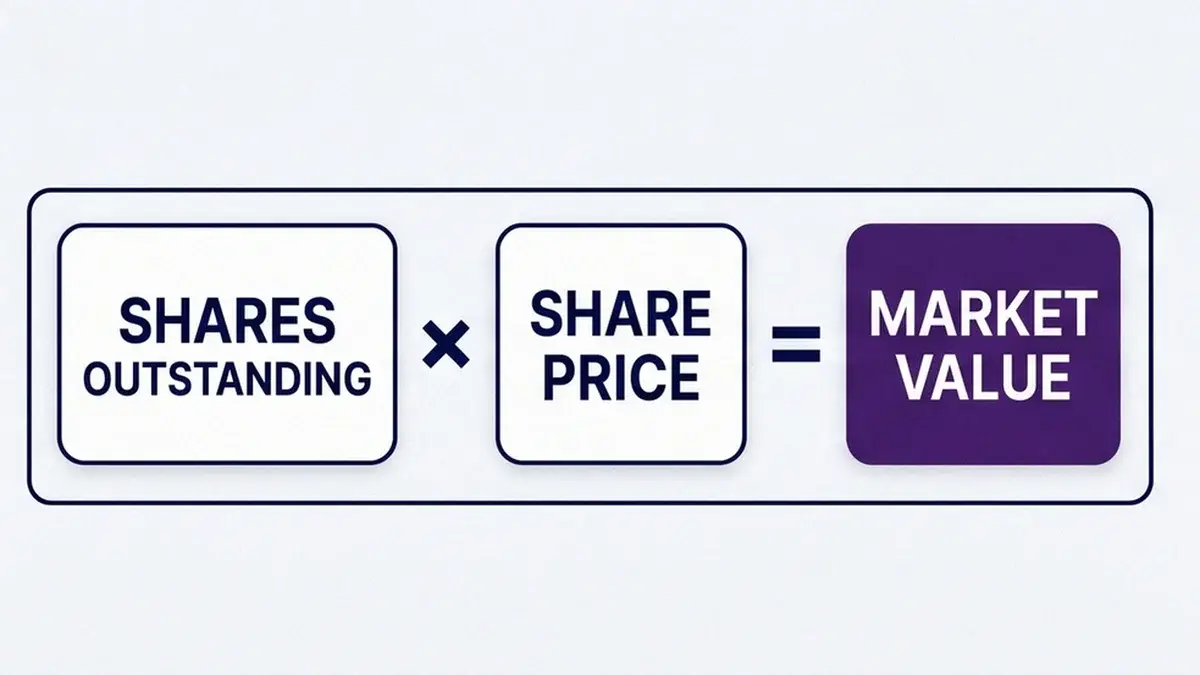
The market cap formula is short:
Market cap = current share price x shares outstanding.
“Shares outstanding” means all the shares the company has issued and that are held by investors. Multiply that count by the live price and you have the market capitalisation. Both inputs matter: if the price doubles and the share count holds, the cap doubles; if the company issues many new shares, the cap can climb even when the price hardly moves.
One caution. Some sources quote “free float” market cap, which counts only the shares available to trade and excludes large blocks locked away by founders or the state. The plain formula uses total shares, so when two figures for a cap disagree, a free-float difference is often why.
A worked example you can follow
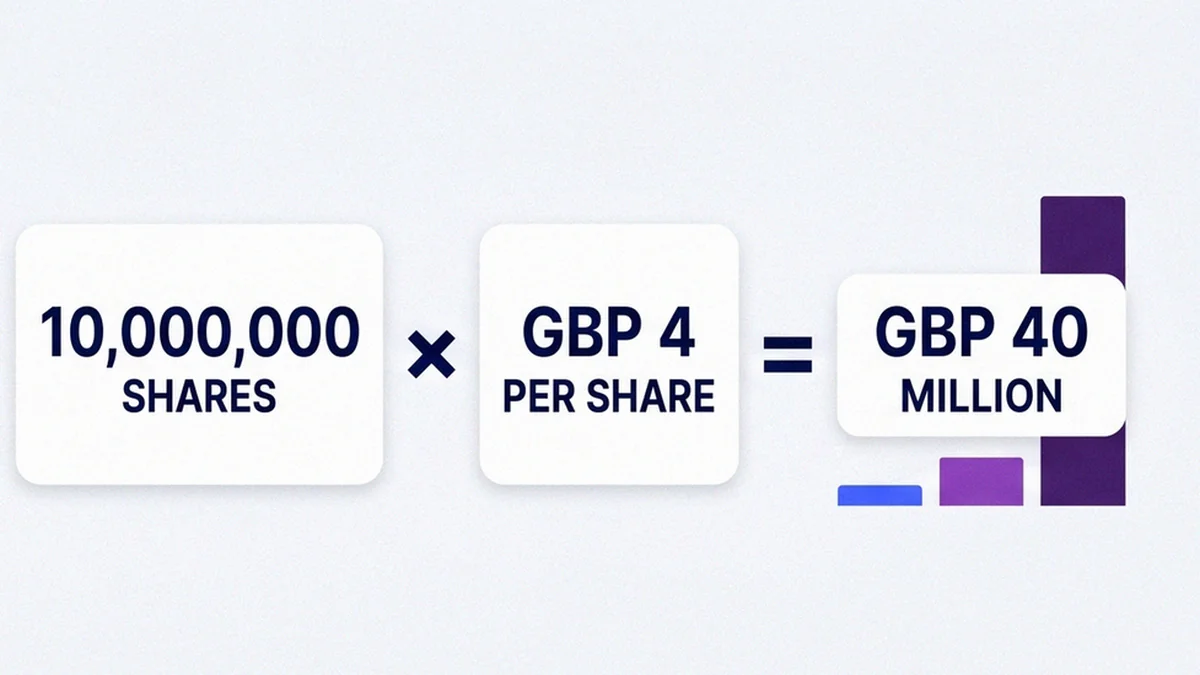
Numbers make it stick. None of these describe a real company; they only show the arithmetic. For example, imagine a company with 10 million shares outstanding, trading at GBP 4 per share. Run the formula:
10,000,000 shares x GBP 4 = GBP 40 million. That is the market cap.
Now watch each input. If the price rises to GBP 6 with the share count unchanged: 10,000,000 x GBP 6 = GBP 60 million, a bigger tag purely from price. Or keep the GBP 4 price but assume 20 million shares: 20,000,000 x GBP 4 = GBP 80 million, a lower-priced share but a larger company, because share count does the heavy lifting.
That second twist is the whole reason market cap exists. Share price alone would rank the GBP 6 company above the GBP 4 one, yet the GBP 4 business is larger.
What the large, mid and small cap bands mean
Once you can calculate the number, you can sort companies into size bands: large cap, mid cap and small cap, with micro cap below those. The exact cut-offs vary by provider and currency, so treat them as broad zones, not hard lines.
| Band | Rough idea | What it tends to signal |
|---|---|---|
| Large cap | The biggest, most established companies. | Usually steadier, widely followed, easy to trade in size. |
| Mid cap | Sizeable but still growing businesses. | A middle ground of growth potential and bumpier prices. |
| Small cap | Smaller companies, often younger. | More room to grow, more volatility, thinner trading. |
The large cap versus small cap split is most people’s shorthand for risk. A large cap is generally easier to buy and sell without moving the price, and draws more coverage. A small cap can grow faster from a low base, but its price can swing hard and buyers can be scarce when you sell. Neither band is “better”; they behave differently, which is why a spread across bands can smooth a portfolio.
What market cap tells you, and what it hides
Market cap answers one question well: how big does the market think this company is right now? That makes it a clean tool for comparing scale and screening a long list down to a shortlist.
What it does not tell you matters just as much. Cap says nothing about debt: a company can carry a modest cap while sitting on heavy borrowings, so owning the business really costs more than the cap suggests. It says nothing about profit, cash flow or whether the price is fair. A high cap is not proof of quality, nor a low cap proof of a bargain; it simply reflects today’s price, which the market can set too high or too low.
It also shifts under your feet. Because price drives it, the cap changes through the trading day, and issuing or buying back shares can move it even when the price does not. Read it as a snapshot of size, then look for what it omits.
Market cap vs other size and value measures
Market cap is the headline size number, but not the only one. A few neighbours are worth knowing.
- Enterprise value. Adjusts market cap for debt and cash to estimate what taking over the business would really cost. Two firms can share a cap yet have very different enterprise values once borrowings count.
- Revenue and profit. These measure what the business actually earns, not what the market prices it at. A large cap with thin profits and a small company with strong earnings tell a story the cap misses.
- Share price. On its own, the least useful for size, because it ignores share count.
- Valuation ratios. Measures that compare price to earnings or sales try to judge whether a share looks dear or cheap. The cap makes no claim about value.
The clean split: market cap measures size, valuation ratios attempt worth, and enterprise value bridges the two by adding the debt you would inherit. Keep the jobs separate and the numbers stop blurring.
Read market cap before you buy
Run this quick pass whenever a market cap figure catches your eye.
- Did I check the cap, not just the share price, to judge size?
- Which band does it sit in, and does that match the risk I want?
- Is this total-shares or free-float cap, if two sources disagree?
- Have I looked at debt, so enterprise value is not far bigger than the cap?
- Have I checked revenue and profit, not assumed a big cap means a strong business?
- Am I treating the cap as a snapshot that moves with price, not a fixed fact?
- For a high-priced large cap, can a fractional share get me in cheaply?
If any line is blank, fill it before you commit money. Market cap starts the analysis; it does not finish it.
What to do next
You can now size any company in one calculation and read the bands with a clear head. The next step is to act on it without a high share price in your way: on Volity you hold real shares and fractional shares in one commission-free account, so a slice of a large cap costs only a small amount, and a $0 multi-currency wallet keeps funds ready. Rehearse on the free demo first. OPEN A VOLITY ACCOUNT, or browse the stocks hub. SEE FEES AND ACCOUNT TYPES.
Reviewed by: A. Bennett, Volity editorial desk.
Data integrity: every product figure here (commission-free trading, real shares and fractional shares in one account, $0 multi-currency wallet, free demo) is verified against Volity’s published account and fee docs. The market cap example uses invented illustration numbers, clearly framed as such.
Related Volity guides
Related coverage on Volity
- Fundamental Analysis in Stock Trading: A Working Definition
- What Is a P/E Ratio and How to Use It
- Growth Investing vs Value Investing: Which Style Fits You?
- ETF vs Index Fund: The Difference and Which to Pick
- How to Start Stock Trading: A 2026 Beginner Guide
Frequently asked questions
How do you calculate market cap?
Multiply the current share price by the total shares outstanding. For example, 10 million shares at GBP 4 each gives a market cap of GBP 40 million. The price changes through the day, so the cap does too. Some sources use only the freely traded shares, called free float, which produces a smaller figure.
What is a good market cap?
There is no single “good” number, because a higher cap is not automatically better. What suits you depends on the risk you want. Large caps tend to be steadier and easier to trade; small caps can grow faster but swing harder. Match the band to your goals rather than chasing the biggest figure.
Is a higher market cap better?
Not on its own. A higher market cap means the market values the company more, not that the share is a better buy or the business is healthier. A large cap can still be overpriced, and a small cap can be a strong performer. Read the cap alongside debt, profit and price.
What is the difference between market cap and value?
Market cap measures size: price times shares. Value asks whether that price is fair, using measures that compare price to earnings, sales or assets. A company can have a large cap and still look poor value, or a small cap and look good value. Size and worth are separate questions.
What is the difference between market cap and enterprise value?
Market cap counts only the equity: share price times shares outstanding. Enterprise value adjusts that for debt and cash to estimate the full cost of owning the business outright. Two companies with the same cap can have very different enterprise values once borrowings are added in.
Sources
The guidance above draws on the following public sources.
- Corporate Finance Institute – the market cap formula
- Corporate Finance Institute – enterprise value adds debt
- Nasdaq – look up a live market cap
- Nasdaq – an index weighted by size
- World Federation of Exchanges – domestic market capitalisation statistics
- World Federation of Exchanges – the global body for exchanges
- Euronext – market cap on a listing page
- Cboe – free float and traded volume
- Federal Reserve Board (Financial Accounts, Z.1) – total market value of equities
- arXiv (Age and market capitalization drive large price variations) – smaller caps swing harder