
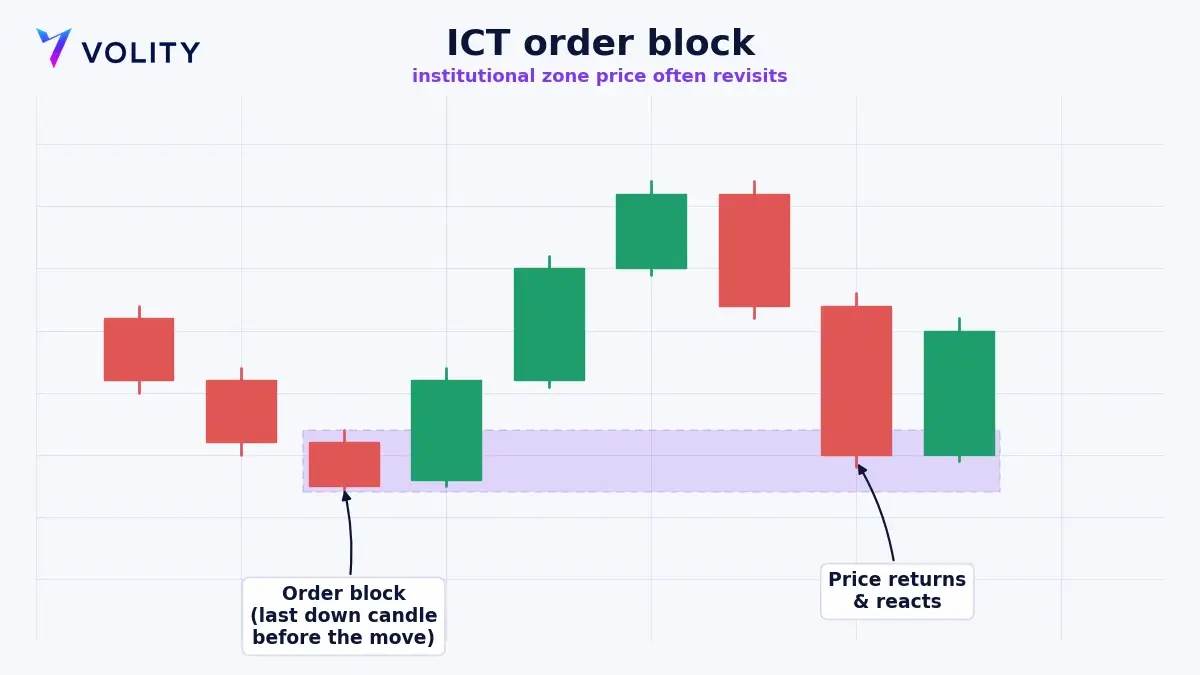
An ICT order block is the last opposite-colour candle before an impulsive move that breaks structure. A bullish order block is the final down candle before a strong rally; a bearish order block is the final up candle before a sharp drop. Price often returns to that candle before continuing in the direction of the move, and that return is where the setup earns its keep.
What is an ICT order block?
The ICT order block is the Inner Circle Trader’s more precise take on a classic chart idea. The logic runs like this: a large institution cannot fill a big order at one price on a venue like the CME without moving the market against itself, so it leaves a footprint. That footprint is the final candle in the opposite direction just before price accelerates away. A last down candle before a rally, or a last up candle before a sell-off, marks the area where those orders were resting in the order book, and the market tends to revisit it to fill what was left behind before carrying on.
The word institutional describes the pattern’s logic here, not a claim to read anyone’s book. What you can actually see is the candle before the impulsive move, and that candle becomes a zone you can mark and reuse. It is one of the most-used tools in smart money concepts, the price-action approach that grew out of the same body of teaching.
How is an ICT order block different from a normal order block?
Search for order block ICT and you will find stricter rules than the generic version uses. A normal order block is often drawn as any base before a move, the same broad supply and demand idea used across trading. The ICT definition adds conditions that filter that raw technical analysis for quality.
| Criterion | Generic order block | ICT order block |
| The candle | Any consolidation base before a move | The last opposite-colour candle before the move |
| Move quality | Any move away | Impulsive displacement that breaks structure |
| Extra confirmation | Not required | Ideally leaves a fair value gap |
| Entry logic | Return to the zone | Mitigation: return to fill unfilled orders, then continue |
The extra rules exist to keep you out of weak zones. A base that never causes a real move is not an ICT order block, however tidy it looks on the chart.
How do you identify an ICT order block?
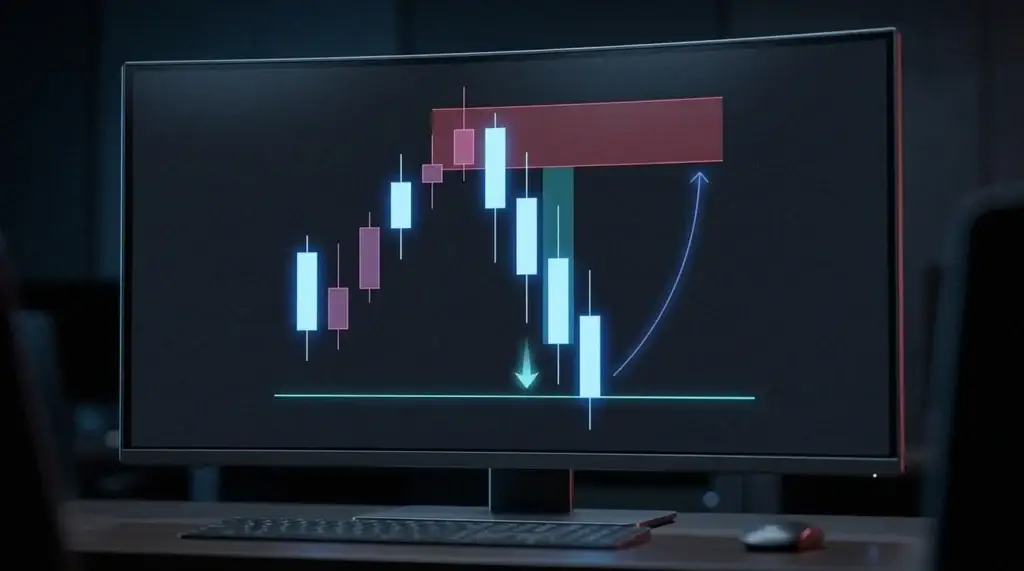
- Find an impulsive move that broke a prior swing, a clear break of structure.
- Step back to the candle immediately before that move began.
- For a bullish order block, take the last down-close candle before the rally. For a bearish order block, take the last up-close candle before the drop.
- Draw the zone from the open to the close of that candle, sometimes extended to include its wick.
- Check for a fair value gap inside the impulsive leg; its presence strengthens the block.
What makes a valid ICT order block?
Displacement matters most. The move away from the block should be impulsive, a wide and decisive candle rather than a slow drift. That move also needs to break a prior swing, which confirms real intent behind it, and a fair value gap inside the impulsive leg is the imbalance a strong block tends to leave. A fresh block beats a mitigated one because the unfilled orders still sit in the book. Higher-timeframe alignment then adds weight: a block sitting at a well-tested support or resistance level on the daily chart carries more than one floating inside a range.
How do you trade an ICT order block?
- Mark a valid, fresh order block after an impulsive break of structure.
- Wait for price to retrace back into the zone; this return is called mitigation.
- Look for a reaction inside the block, such as a lower-timeframe shift in your direction, to time the entry.
- Place the stop just beyond the far side of the block, where the idea is invalidated.
- Target the next structural level or liquidity pool, aiming for a reward that justifies the tight stop.
The mitigation entry is what separates order-block trading from chasing. You let the market come back to you at the footprint, which gives a defined risk and a clear point of failure instead of an entry taken in the middle of a move.

ICT order block, breaker block or rejection block: which is which?
These three get mixed up because they all mark institutional footprints, but they form in different ways. An ICT order block is a fresh block that price returns to and respects. A breaker block is an order block that failed and flipped, now working as support or resistance from the other side. A rejection block is drawn from candle wicks at a sharp turn rather than from the bodies. Knowing which one you are looking at tells you whether to expect continuation, a role reversal, or a fade off the wick.
What are the common ICT order block mistakes?
- Marking every base as a block. Without displacement and a break of structure, a base is just consolidation.
- Using stale blocks. A block price has already mitigated has less unfilled order flow left in it.
- Skipping the reaction. The block is a zone of interest, not an automatic buy or sell, so wait for confirmation inside it.
- Fighting the higher timeframe. A block that leans against a strong daily trend is low quality from the start.
What is a breaker block, and how does it relate to an order block?
The breaker block is the ICT order block’s close cousin, and understanding one sharpens the other. A breaker block is an order block that failed and flipped role. Where a fresh order block is a level price respects, a breaker is a level price broke through, and it now works from the opposite side.
Picture a bullish order block that should have held as demand. Price trades into it and, instead of bouncing, closes clean below it. That failure is information. The orders that were meant to support price were overwhelmed, so the zone flips: the old demand becomes supply, and traders now watch it as resistance from beneath. That flipped zone is the breaker block.
- An order block is a fresh footprint price returns to and respects, traded in the direction of the impulsive move.
- A breaker block is a failed order block that price closed through, now traded in the opposite direction.
The practical value is that a failed order block is not wasted. When your ICT order block gets run through, do not just discard it; mark it as a potential breaker and watch how price treats it on the retest. Many strong reversals are built on a breaker block, which is why the steadier order-block traders track both the levels that hold and the ones that break.
Putting the ICT order block to work on Volity
Order-block trading needs charts that let you mark precise zones and execution that fills you cleanly on the retest. Volity gives you CFD trading across forex, indices, commodities and crypto from one account on Volity MT, so you can apply the ICT order block method to any of those markets from the same platform. You can open an account for $0, rehearse the mitigation entry on a demo, invest from as little as $1, and start trading from $1.
Leverage of up to 1:500 on selected forex pairs lets you size to the block’s boundary for a tight, defined stop, and the charting tools on the Volity platform make marking and revisiting zones straightforward, with 99.6% of orders filled in under a second so your entry lands where you expect. That leverage cuts both ways. It magnifies losses as much as gains, so size every position from its stop distance. You are trading your own capital, so size every position against the block’s invalidation level, keep to the hours when the major dealing desks are active, and confirm the spread on your instrument on the charges and fees page before you commit. Volity operates under CySEC regulation through UBK Markets, licence 186/12.
ICT order block FAQ
What is a bullish ICT order block?
A bullish ICT order block is the last down-close candle before an impulsive rally that breaks structure. It marks the zone where buy orders drove price sharply higher. Traders watch for price to retrace back into that candle’s range, react, and continue up, treating the block as a demand zone with a stop below its low.
How is an ICT order block different from supply and demand?
They overlap, but the ICT order block is more specific. Supply and demand zones are broad areas where price previously turned. An ICT order block pins the zone to a single candle, the last opposite-colour candle before an impulsive, structure-breaking move, and often requires a fair value gap for confirmation. It is a tighter, rule-based version of the same demand-and-supply logic.
What timeframe works best for ICT order blocks?
The 1-hour, 4-hour and daily charts produce the most reliable blocks, because the displacement represents more order flow. A common workflow marks the block on a higher timeframe and refines the mitigation entry on a lower one, such as the 5-minute or 15-minute. Very low timeframes create many blocks but a higher share of failures.
What invalidates an ICT order block?
A decisive candle close through the far side of the block invalidates it. If price trades back into a bullish order block and closes clean below it rather than reacting, the demand is gone and the block should be dropped. That failed block can then flip into a breaker block, offering a trade in the opposite direction.