There are two ways to buy Visa stock. You can own real Visa shares by opening a share-dealing account with a broker that offers US-listed shares, because Visa Inc. trades as V on the New York Stock Exchange. Or you can trade a Visa CFD, a contract that tracks the share price and lets you go long or short without owning the shares. Volity gives you the second route: CFD price exposure to Visa, not share ownership.
The short version
- Visa Inc. trades as V on the New York Stock Exchange, so buying real shares means using a broker with access to US-listed stocks.
- Owning shares gives you a stake in the company, any declared dividends, and voting rights on the Class A shares.
- A Visa CFD is a contract that mirrors the share price. You never own the stock, and you can trade it in either direction.
- CFDs use leverage, which magnifies profit and loss, and most retail CFD accounts lose money.
- On Volity you open an account for $0 and start trading from $1, with leverage on single shares capped well below other markets.
What is Visa stock (V)?
Visa Inc. is one of the world’s largest payments companies. It runs the network that moves money between banks, merchants, and cardholders. Visa does not issue cards or extend credit; the banks do that, while Visa provides the branded payment products and the processing rails behind them, through its VisaNet network. The company is run from San Francisco, and its shares trade under the ticker V. Because it is listed in the United States, quoted prices are in US dollars.
Visa went public in March 2008 in what was, at the time, the largest initial public offering in US history, pricing at 44 dollars a share. It is a large, established financial-infrastructure name, not a speculative growth stock. Net revenue was around 35.9 billion dollars in fiscal 2024 and grew to about 40 billion dollars in fiscal 2025, up 11 percent, with full-year net income above 20 billion dollars. Visa runs its financial year to the end of September and pays a quarterly dividend when its board declares one, which it raised by 14 percent alongside the fiscal 2025 results.
Visa the stock versus a Visa card: clearing up the confusion
A quick point that trips up first-time searchers: buying Visa stock has nothing to do with getting a Visa card. The card in your wallet is issued by your bank. The stock, ticker V, is a small ownership stake in the company that runs the payment network. The two share a name and a logo, and that is where the connection ends. Visa also has more than one class of share, but for a private investor V is the Class A stock a broker will sell you.
Buying the actual shares makes you a part-owner, and the process matches buying any US-listed stock through a broker.
- Open a share-dealing account with a broker or investment platform that offers US-listed shares in your country.
- Fund the account. Visa shares are priced in dollars, so your platform will convert your local currency, usually for a small FX fee.
- Search for the ticker V and check you have the correct listing, Visa Inc. on the New York Stock Exchange.
- Decide how much to invest. If a full share is more than you want to commit, many brokers let you buy a fractional share, a slice of one share.
- Place a market or limit order and hold the shares in your account.
Once you hold the shares you are entitled to any dividend the company pays and you can vote on shareholder matters. This route suits long-term investors who accept that the holding can fall as well as rise. If you are new to this, our guide on how to start stock trading walks through the basics, and fractional shares explained covers investing with smaller amounts.
The steps are the same for a UK investor, with two extra points. First, you can usually hold US shares like Visa inside a stocks and shares ISA, a tax-efficient account, or in a standard share-dealing account. Second, because Visa is priced in dollars, expect a currency conversion on each trade, and many platforms ask you to complete a tax form to cut withholding on dividends. Nothing about buying Visa requires a US account or address.
How to invest in Visa with a CFD on Volity
A contract for difference, or CFD, is an agreement to exchange the change in a price between when you open a trade and when you close it. A Visa CFD tracks the V share price, so you are trading the price movement without buying or holding the underlying shares. This is the exposure Volity provides, and it works differently from owning stock in a few ways.
- You do not own Visa shares, so there are no voting rights and no shares to transfer. Dividends are handled as a cash adjustment on your position, not a payment from the company.
- You can go short as well as long, so you can trade a falling price too.
- You trade with leverage, using your own capital plus borrowed exposure. There is no funded or prop account involved, only your deposit.
On Volity you open an account for $0, can add funds and invest from $1, and start trading from $1. Visa trades alongside other shares, indices, and forex on the Volity MT platform. Volity is operated under CySEC licence 186/12 through UBK Markets, so it follows European retail-protection rules. A free demo account lets you see how a Visa CFD behaves with virtual funds before you risk real money.
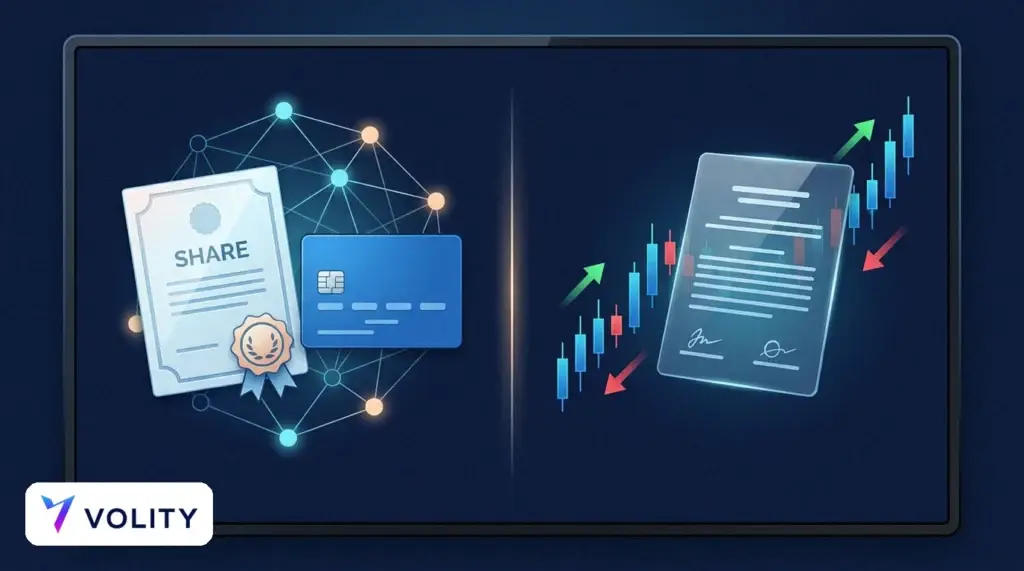
The table sums up the practical differences so you can match the method to what you are trying to do.
| Feature | Real Visa shares | Visa CFD on Volity |
| Ownership | You own the shares | No ownership, price only |
| Direction | Profit if the price rises | Go long or short |
| Dividends | Paid to you when declared | Position adjustment |
| Voting rights | Yes, on Class A shares | No |
| Leverage | None by default | Product-dependent and capped |
| Typical use | Long-term investing | Shorter-term trading |
| Held through | Share-dealing account or ISA | Volity MT platform |
What are the risks of trading a Visa CFD?
Leverage is the main risk. It works on both sides, so a small move against you can wipe out a large part of your deposit. European regulators have found that between 74 and 89 percent of retail CFD accounts lose money, and the UK regulator lists CFDs among its high-risk investments. Treat any single-stock CFD as an active position that needs managing.
Leverage on a single share like Visa is far lower than the up to 1:500 quoted on some other markets. Under the retail rules that Volity follows through CySEC, leverage on individual equity CFDs is capped at 5:1, because a single share swings more than a broad index or a major currency pair. An overnight financing cost also applies while a CFD is open, which eats into a long hold. Sizing positions with care and using a stop-loss order are the basic defences, and our note on fundamental analysis shows how to read a business like Visa.

How to invest in Visa
Whether you buy shares or trade a CFD, the same discipline applies first.
- Decide your aim. Long-term ownership points to real shares; trading the price move points to a CFD.
- Pick the right account and check the fees, the spread, and any financing costs.
- Read the company. Look at Visa’s revenue trend and margins, not just the chart.
- Size the position to a loss you can accept, and set your risk controls before you enter.
- Practise first. A demo account lets you rehearse the mechanics with no money at stake.
Related guides
Frequently asked questions
Can I buy Visa stock on Volity?
You cannot buy real Visa shares on Volity. Volity offers a Visa CFD, which gives you price exposure to V without owning the underlying stock. To own actual shares you would use a share-dealing account that lists US shares. The CFD is for trading the price move, in either direction, with leverage.
Is Visa stock the same as a Visa card?
No. A Visa card is a payment product issued by your bank. Visa stock, ticker V, is a share in Visa Inc., the company that runs the payment network. Buying it gives you a stake in that business and any dividend it declares, but no card and no credit line.
How much money do I need to trade Visa on Volity?
Opening a Volity account costs $0. You can add funds and invest from $1, and start trading from $1. Because a CFD is leveraged, the margin to open a Visa position is a fraction of its full value, so only risk money you can afford to lose.
Is Visa a good stock to buy?
That depends on your goals and your view of the company, and this article is general information, not personal advice. Visa is a large payments business with growing revenue, but any share price can fall, and past results are no guide to the future. Do your own research, or speak to a regulated adviser, before you buy shares or open a CFD.
This article is general information and does not take account of your personal circumstances. CFDs are complex instruments and carry a high risk of losing money quickly through leverage. Consider whether you understand how CFDs work and whether you can afford the risk before trading.