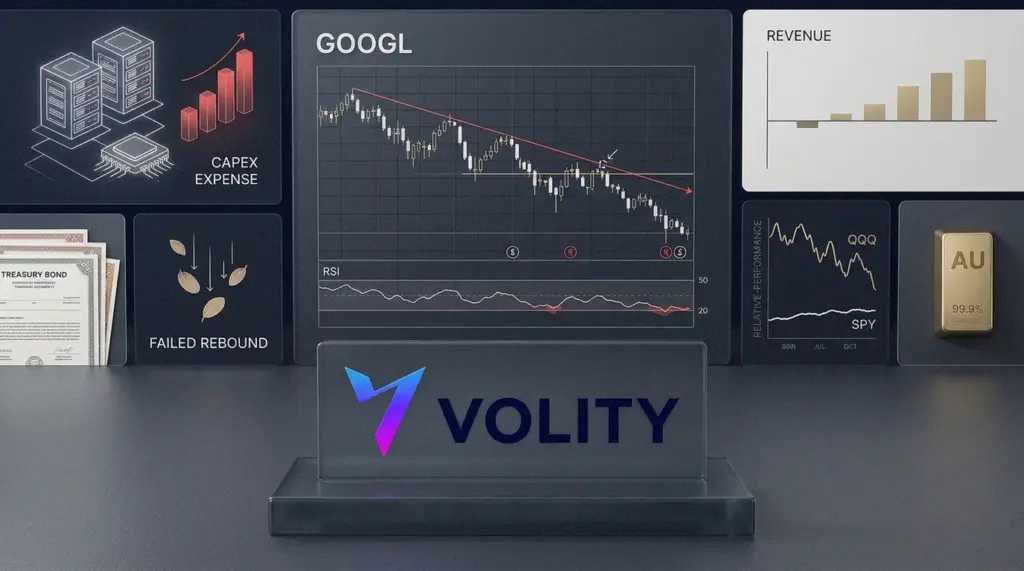
When the market stops believing a good report
Wall Street enjoys good news until it falls short of a very expensive promise. Alphabet and ServiceNow delivered business growth, yet both shares came under fierce pressure.
Investors focused less on the finished quarter than on the next one. That distinction now matters most in large technology stocks.
By 29 October, the Nasdaq-heavy QQQ fell far more sharply than the broad-market SPY. Meanwhile, long-dated Treasury fund TLT held gains, signalling demand for a defensive hedge.
The moves do not prove that a broad sell-off has begun. They do show where investors see the greatest valuation risk.
Alphabet finds little room for error
Alphabet reported revenue of $127.58 billion, up 25% from a year earlier. Yet the figure fell short of analysts’ expectations.
Adjusted earnings reached $2.67 a share, against a consensus estimate near $3.02. For a company valued on persistent outperformance, that gap carried weight.
Google Search revenue rose 12% year on year. The previous quarter had produced 17% growth.
At the same time, Alphabet absorbed heavier costs from artificial intelligence investment. Lower values on some investments also weighed on reported results.
GOOGL shares dropped more than 13% during the session. The decline erased hundreds of billions of dollars from Alphabet’s market value at various points.
Still, a 10% to 13% gap lower does not create an automatic short sale. Late sellers can suffer when early bears lock in gains.
Traders should watch the opening range instead. A recovery above its high could trigger a sharp squeeze.
Failure to hold the opening low would tell a different story. That outcome matters more if QQQ also extends its decline.
ServiceNow pays for slower expectations
ServiceNow presented a cleaner quarter on the surface. Revenue rose 20.5% to $4.11 billion and exceeded forecasts.
Adjusted earnings came in at $1 a share, slightly below the $1.02 consensus estimate. However, the market’s sharper concern sat in forward demand.
Current remaining performance obligations, or cRPO, rose 21% in constant currency to $13.65 billion. Management projected 18.5% growth for the following quarter.
That is not a broken business model. It is a slower future growth rate for a stock priced for exceptional momentum.
NOW shares fell roughly 18% to 23% in early trading. The move ranked among the company’s most severe single-session declines.
Acquisition spending added to the unease. Interest costs rose after deals including Armis, leaving net income more exposed than investors expected.
A bearish case needs confirmation after the gap. A weak rebound followed by an intraday support break offers better evidence than the first red candle.
The line between QQQ and SPY
QQQ fell about 1.3% to 1.6%, while SPY lost roughly 0.5%. The spread suggests a concentrated technology unwind rather than broad investor panic.
That distinction can change quickly. Banks, industrial groups and consumer shares would need to weaken before the selling looked truly market-wide.
- QQQ steadies while SPY holds: pressure remains concentrated in technology.
- QQQ stays below its opening range: sellers retain control of the sector.
- SPY breaks its morning low: the risk of a wider retreat increases.
- Both funds reclaim first-hour highs: the bearish impulse has lost force.
Yesterday’s support levels can quickly become resistance after a large gap. Each session needs fresh levels rather than inherited assumptions.
Bonds offer protection, gold does not
TLT’s strength alongside weaker technology shares reflects a cautious shift towards duration. One session alone cannot establish a lasting Treasury rally.
A stronger signal would require several days of rising TLT and falling QQQ. Falling 10-year Treasury yields would strengthen that case.
Gold offered a less comforting message. GLD also declined as equities weakened, breaking the simple assumption that fear always lifts bullion.
GLD needs to reclaim meaningful intraday levels before it becomes a useful confirmation tool. Until then, it remains an unreliable hedge for this particular sell-off.
Insider sales need context
Insider transactions can attract more attention than they deserve. A holder’s sale of 35,000 AIR shares, worth roughly $3.41 million, does not prove weakening operations.
The same caution applies to reported activity in INSW, RDWR, TAL and ASML. Tax bills, preset trading plans and portfolio rebalancing can all explain a sale.
Investors should demand two further signals before acting. Unusual volume and a clear technical support break provide a more useful filter.
What traders should watch next
- NOW: Watch for failed rebounds, rather than chasing an already extended gap.
- GOOGL: Treat the first-hour range as the key test of seller control.
- ORCL: Consider long positions only with clear relative strength against QQQ.
- QQQ and SPY: Use their divergence to judge whether weakness is spreading.
- TLT: Look for sustained strength before calling it a durable defensive trade.
The market has not abandoned technology. It has simply become far less forgiving about the price paid for future growth.
Related coverage on Volity
- What Is a P/E Ratio and How to Use It
- Fundamental Analysis in Stock Trading: A Working Definition
- Growth Investing vs Value Investing: Which Style Fits You?
- Fractional Shares Explained: How to Start Investing With $50
- How to Start Stock Trading: A 2026 Beginner Guide
- Dividend Investing for Beginners: How to Start