Alexander Bennett, Volity Markets analyst desk: “The cup and handle is one of the few classical patterns where the win rate has held up through the algorithmic era , but only when traders respect three rules. First, the cup must be at least seven weeks long on a daily chart. Second, the handle pullback should not exceed a third of the cup’s height. Third, the breakout needs a visible expansion in volume against the recent average. Without all three, the pattern is just a shape, and algorithmic liquidity sweeps will take out the obvious stops.”
Technical chart patterns like the Cup and Handle are probabilities, not guarantees. Algorithmic false breakouts routinely take out retail stop-losses at the pattern neckline. High-volatility markets can invalidate a handle in milliseconds. Always use disciplined stop-loss placement and never trade with capital you cannot afford to lose. Past performance is not indicative of future results. Capital at risk.
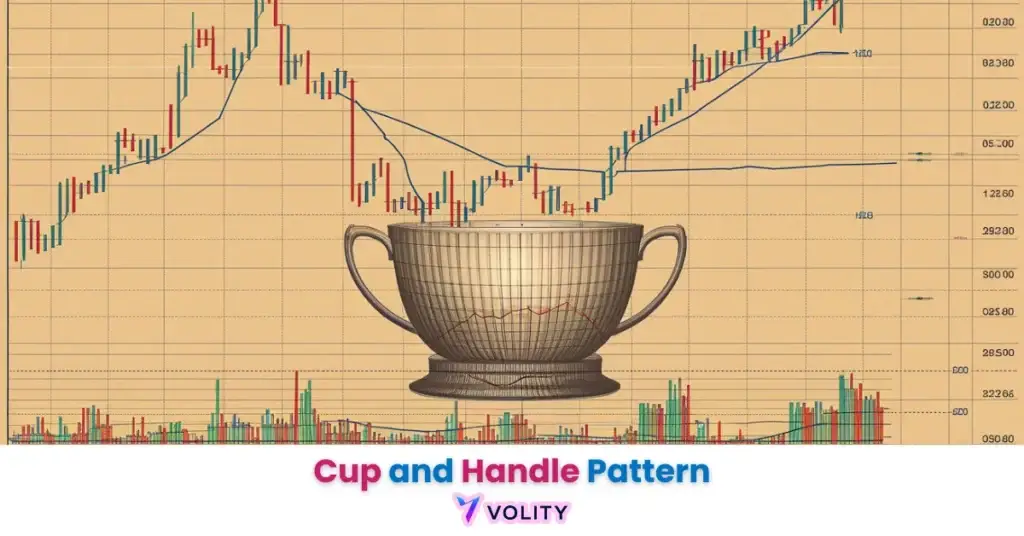
The Cup and Handle is a bullish continuation structure. Thomas Bulkowski measures a 5% break-even failure rate and a 54% average rise on bull-market upward breakouts across 913 perfect trades, ranking it 3rd of 39 chart patterns. This guide covers identification, including rounded ‘U’ shapes and volume expansion on the breakout. Identifying the inverted bearish counterpart allows traders to execute profitable short-selling strategies during market distribution phases.
The Cup and Handle pattern identifies a foundational chart formation used by technical analysts to signal the continuation of a prevailing uptrend. Bulkowski’s published results for the Cup with Handle put its break-even failure rate at 5% and its average rise at 54%, ranking it 3rd of 39 chart patterns, which is what makes it one of the better-documented setups for active speculators. By visualizing the transition from profit-taking to renewed accumulation, traders can project profit targets with a high degree of mathematical precision.
The 2026 technical landscape is defined by the use of high-frequency algorithms that target liquidity at the ‘rim’ of the cup, making precise volume verification essential for retail success. As markets navigate the higher-for-longer interest rate environment, understanding the difference between a valid 1-month handle and a failed trend exhaustion is a critical skill. This guide identifies the seven core criteria for the bullish Cup and Handle and reveals the strategic execution paths for its inverted bearish counterpart.
While understanding Cup and Handle Patterns is important, applying that knowledge is where the real growth happens. Create Your Free Forex Trading Account to practice with a free demo account and put your strategy to the test.
What is the Difference Between Cup and Handle and Inverted Patterns?
The primary difference between the Cup and Handle and the Inverted Cup and Handle identifies their directional bias, where the traditional pattern signals bullish continuation and the inverted version reveals a bearish reversal or continuation signal. The bullish Cup and Handle emerges after an uptrend, forming a rounded recovery that signals renewed buying momentum. The inverted pattern appears after an uptrend or consolidation, forming an inverted ‘U’ top that signals distribution and potential downward movement.
Psychological divergence separates these patterns in the 2026 market cycle. During a bullish cup formation, institutional accumulation identifies the underlying buying pressure that creates the rounded bottom and forms the foundation for continued gains. The inverted pattern represents distribution, where large holders take profits at resistance and trigger subsequent selling pressure. Visual identification focuses on the neckline (rim) in both cases, the critical resistance level that, once breached, validates the pattern and activates the measured move target.
The Bullish Cup and Handle requires a pre-existing uptrend and produces a measured move projection that extends the cup’s depth beyond the breakout point. The Inverted Cup and Handle requires that the price break below the handle’s support level, signaling a decline equal to the inverted cup’s depth. Both formations serve continuation purposes, which distinguishes them from reversal patterns like the head and shoulders. Understanding this directional split enables traders to position on the correct side of market momentum during accumulation and distribution phases.
Ready to Elevate Your Trading?
You have the information. Now, get the platform. Join thousands of successful traders who use Volity for its powerful tools, fast execution, and dedicated support.
Create Your Account in Under 3 MinutesHow to Identify the 2026 Bullish Cup and Handle Success Criteria
Like all reversal patterns, identification rests on support and resistance levels, the rim and the breakout above it.
Identifying a valid bullish Cup and Handle rests on a rigorous checklist: a rounded bottom and a shallow handle are what separate the 95% of Bulkowski’s samples that clear the break-even threshold from the 5% that do not. The ‘U’ shape requirement distinguishes valid patterns from unstable V-shaped recoveries, a rounded bottom indicates institutional accumulation, while a sharp V-bottom suggests panic buying that lacks the conviction to sustain higher prices. Duration benchmarks verify that a cup lasting 1–6 months identifies the necessary time frame for institutions to build positions without triggering algorithmic front-running.
Handle depth represents the second critical criterion. On William O’Neil’s original specification a valid handle retraces no more than about a third of the cup’s advance, identifying a shallow consolidation that preserves the underlying bullish momentum. A handle deeper than that signals genuine distribution rather than a pause, and the pattern stops being a high-probability continuation. Trend context matters: the pattern is a continuation signal, so it needs a prior advance to continue. Shapes forming in sideways markets lack the structural support for reliable breakouts.
Traders can reference optimal timeframes for technical patterns to identify the correct time frame for pattern formation. In 2026, the Daily and 4-Hour timeframes verify the most reliable patterns, while 15-minute formations suffer from high false-breakout rates due to algorithmic noise. Volume behavior during the cup formation reveals declining volume at the bottom (accumulation phase) followed by rising volume on the right side as new buyers enter, this volume curve identifies the psychological shift from weakness to strength.
Look for ‘U’ shapes over ‘V’ shapes. A rounded bottom identifies a more sustainable shift in buyer conviction than a sharp V-shaped recovery, which is why O’Neil specified the rounded base in the first place.
Volume and Resistance: How to Confirm High-Probability Breakouts
Pair the volume signal with momentum from the RSI indicator for an extra layer of confluence.
Volume confirmation identifies the fuel behind a Cup and Handle breakout, where a clear expansion above average levels reveals the return of institutional buying pressure at the neckline. The volume curve during cup formation shows a declining trend as the market exhausts sellers at the bottom, this low-volume period indicates a capitulation phase where weak hands exit. Once the price begins recovering on the right side of the cup, volume begins rising, signaling that institutional buyers are accumulating the position for the final move.
Breakout validation focuses on the specific candle that closes above the resistance rim on high volume. A breakout candle without visible volume expansion identifies a high-risk ‘liquidity sweep’ that often reverses back into the cup. Institutional traders use this low-volume break to trigger retail stop-losses, only to reverse the price back down and trap leveraged positions. Resistance at the rim requires the left and right peaks to sit at broadly the same level, because that alignment is what makes the neckline a single valid resistance level across both sides of the cup.
Traders can evaluate Elliott Wave Theory: Rules & Patterns to integrate wave patterns with cup and handle formations. In 2026, the cup-and-handle breakout often coincides with the completion of an Elliott wave 4 consolidation, confirming the start of wave 5 and the final impulse move. Using 2026 Order Flow tools identifies large-block accumulation within the handle, whale buying activity precedes the breakout by 1-3 days as institutional players position before retail participation drives volume.
2026 Pattern Benchmarks: Success Rates and Profit Potential
Thomas Bulkowski’s measured results are the benchmark worth quoting, because they state exactly what was counted. The Cup with Handle shows a 5% break-even failure rate and a 54% average rise on bull-market upward breakouts, from 913 perfect trades, ranking 3rd of 39. The Inverted Cup with Handle shows an 18% break-even failure rate and a 17% average decline, ranking 6th of 36. Read the failure rate for what it is: the share of patterns that fail to move even 5% in the breakout direction, not a win rate on a live account.
| Pattern Type | Break-even failure rate | Average move (Bulkowski) |
| Cup with handle (up breakout) | 5% | +54% average rise |
| Inverted cup with handle | 18% | -17% average decline |
| Cup duration (O’Neil) | 7 to 65 weeks | 12% to 33% deep |
| Handle Depth | < 50% of Cup | N/A |
| Throwback rate | 62% | 61% meet the price target |
Cup duration on O’Neil’s specification runs seven to 65 weeks on a daily chart, with a depth of 12% to 33% from rim to base. Handles lasting one to four weeks represent optimal timing; longer handle periods signal weakening of the original uptrend. Volume expansion on the breakout is the confirmation that matters, and its absence indicates insufficient conviction for a sustainable move.
Turn Knowledge into Profit
You have done the reading, now it is time to act. The best way to learn is by doing. Open a free, no-risk demo account and practice your strategy with virtual funds today.
Open a Free Demo AccountHow to Trade the Inverted Cup and Handle Strategy in 2026
The Inverted Cup and Handle strategy identifies a bearish trading path where a breakdown below the rounded top’s support line precedes an average 17% decline in Bulkowski’s samples, with an 18% break-even failure rate. Entry execution focuses on selling the breakdown of the handle’s upward-sloping support line, with orders placed immediately below this key technical level. The stop-loss placement identifies the invalidation point, setting a stop above the handle’s high confirms that if the bearish thesis fails, the trader exits before losses exceed acceptable risk thresholds.
Target calculation requires measuring the depth of the inverted cup from the top to the bottom point, then projecting that distance downward from the support rim. This measured move identifies the profit-target level where institutional distribution typically concludes. The 2026 bearish context reveals that the inverted pattern identifies over-extended exhaustion in trending crypto and forex pairs after sustained rallies, algorithmic momentum breakdowns often coincide with inverted cup formations on daily charts.
Worked illustration: take an inverted cup and handle on the GBP/USD daily chart. Price consolidates in a rounded-top formation over 3 weeks, creating a clear handle consolidation. At the start of week 4, the price broke below the handle support at 1.2450, triggering short-entry orders with stops above the handle high at 1.2600. The measured move target identified as 1.2100 (equal to the cup’s depth). The pair worked down toward that target over the following sessions. Past performance is not indicative of future results.
Traders can reference Forex Risk Management: 10 Strategies to Protect Your Capital for advanced stop-loss and position-sizing techniques specific to inverted patterns. Managing risk on bearish setups requires aggressive stops because inverted patterns trigger the most severe false breakouts when market sentiment shifts abruptly on policy announcements or economic data surprises.
Advanced Techniques: Using Fibonacci and RSI with the Cup and Handle
Advanced confirmation techniques identify the synergy between Fibonacci retracements and RSI oscillators to filter out low-probability Cup and Handle setups in 2026. The 38.2% handle rule identifies that institutional traders view this Fibonacci level as the optimal shallow consolidation point, handles that bounce back to 38.2% of the cup’s depth represent the most sustainable continuation patterns. Handles retracing half the cup or deeper are the ones O’Neil’s specification rules out, which puts the workable band nearer a third of the cup’s depth.
RSI divergence provides a second confirmation layer. Hidden bullish divergence appears as the price forms the right side of the cup, the price makes a lower low while RSI makes a higher low, signaling that selling pressure is weakening beneath the surface. This divergence precedes the breakout by 1-3 candles, providing early warning for traders to tighten entries. Measured move targets extend beyond the initial cup depth projection using the 1.618 Fibonacci extension, identifying a secondary profit-target level where institutional take-profits may occur.
Convergence represents the 2026 standard for high-confidence entries, price must form a valid cup and handle, volume must expand visibly against the recent average, the handle must rest at approximately 38.2% Fibonacci depth, and RSI must show hidden bullish divergence. When these four elements align you are trading the version of the shape Bulkowski measured, rather than something that merely resembles it. Fibonacci Retracement in Forex: What is FIB? explains the technical foundations behind Fibonacci levels and their application to continuation patterns.
Institutional traders combine cup and handle formations with Elliott Wave analysis, Ichimoku clouds, and smart money concepts to create multi-layer confirmation systems.
Key Takeaways
- The Cup and Handle is a bullish continuation formation with a 5% break-even failure rate and a 54% average rise in Bulkowski’s bull-market sample.
- Identification criteria reveal that a rounded ‘U’ shape and a handle no deeper than about a third of the cup are essential for pattern validity.
- Volume confirmation identifies the breakout, requiring visible expansion above the recent average at the neckline.
- The Inverted Cup and Handle is a bearish setup with an 18% break-even failure rate and a 17% average decline.
- O’Neil specified cups of seven to 65 weeks, 12% to 33% deep, with the handle completing within one to four weeks.
- A handle finding support near the 38.2% Fibonacci retracement sits inside O’Neil’s one-third rule, which is why traders watch that level.
Frequently Asked Questions
This article contains references to Cup and Handle patterns, technical chart analysis, and Volity, a regulated CFD trading platform. This content is produced for educational purposes only and does not constitute financial advice or a recommendation to buy or sell any financial instrument. Always verify technical patterns with multiple indicators and use disciplined risk management before trading. Some links in this article may be affiliate links.
Analyst FAQ
How long should a valid cup take to form?
The original specification from William O’Neil called for cups lasting seven to 65 weeks on a daily chart. Patterns shorter than seven weeks are usually noise; cups longer than a year often turn into broader basing structures with different mechanics. The depth typically ranges 12% to 33% from rim to base; deeper cups tend to produce more reliable breakouts.
What invalidates the pattern?
Three conditions. Handle depth exceeding roughly a third of the cup, which signals genuine distribution rather than a shallow pullback. A failure of the breakout to hold for two consecutive sessions on expanding volume. And a rejection back below the handle’s low, which implies the prior structure has broken. Any one of these turns the pattern into a failed setup with an asymmetric short opportunity in some cases.
How is the inverted pattern different to trade?
The geometry inverts but the psychology mirrors. An inverted cup forms after extended strength, the handle is a shallow rally that fails to reclaim the rounded top, and the breakdown is a continuation lower. Inverted patterns historically have lower base rates than standard cups because uptrends end less often by clean topping than downtrends end by clean bottoming. Use them sparingly and demand the same volume and structural confirmation.
What price target is reasonable on a successful breakout?
The classical projection is the cup’s depth added to the breakout level for a standard pattern, or subtracted for the inverted variant. Treat that as a first-target heuristic, not a hard stop. Realised follow-through depends on broader regime , a cup-and-handle breakout in a bullish macro tape with falling real yields runs further than the same pattern in a defensive tape.
External references. ESMA Investor Corner · BIS
Volity operates a trading platform and also publishes educational and analytical content about trading. The content on this page is for educational purposes only and should not be considered financial advice. Volity may benefit commercially when readers open trading accounts through links on this site.
Our content is produced and reviewed under documented editorial standards; see our comparison and review methodology.