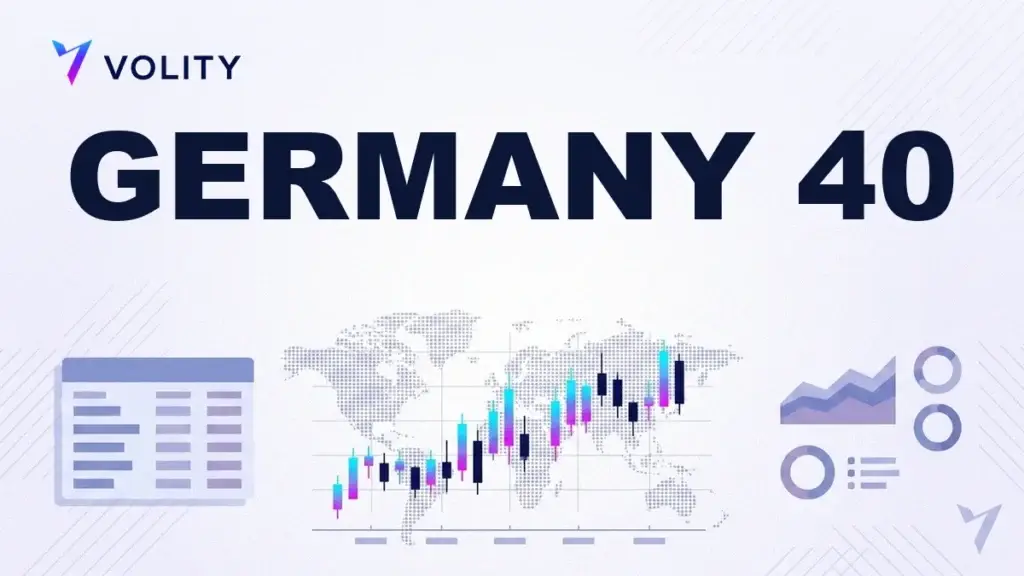
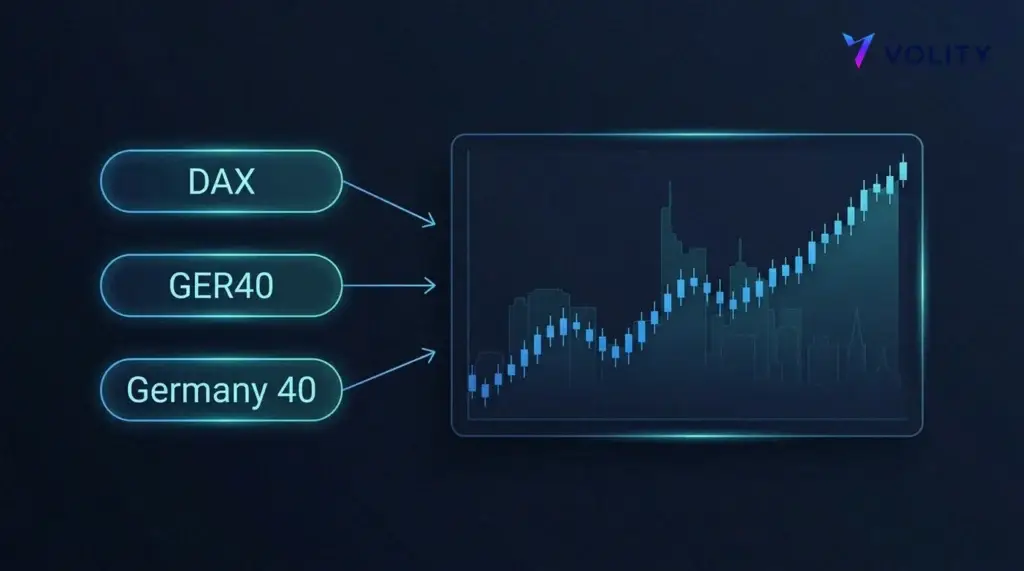
Germany 40 is the name most trading platforms give to the DAX, the index of the 40 largest companies on the Frankfurt Stock Exchange. Trading the Germany 40 as a CFD lets you go long or short on Germany’s benchmark index from a single position on Volity MT, with no shares to own.
What is the Germany 40 index?
The Germany 40 is the DAX under a plain-English name. It tracks the 40 largest and most liquid companies on the Frankfurt Stock Exchange, compiled by Deutsche Börse and its index arm, and it is the headline gauge of the German stock market. On some platforms you will also see the same market written as GER40 or DE40. Volity lists it as GER40 or Germany 40, and whichever label you meet, the price tracks the one underlying index. If you are new to this kind of instrument, our explainer on what indices trading is covers the basics first.
Naming aside, this is a benchmark of large German exporters. Software, industrials, carmakers, chemicals and insurers make up most of its weight, which ties the Germany 40 closely to global demand, the euro and energy costs. That export tilt is the single most useful thing to know about how it behaves.
Why is the DAX called Germany 40?
Trading platforms often relabel well-known indices with descriptive region-plus-number names so instruments read consistently across a global product list. The DAX becomes Germany 40, the FTSE 100 becomes UK100, and the S&P 500 becomes US500. The number simply tells you how many companies the index holds.
The “40” part is recent. Until September 2021 the index held 30 companies and traded as the DAX 30. Deutsche Börse then expanded it to 40 members to widen its coverage of the German market after a round of index reform. That is why Germany 40 replaced the older Germany 30 label on most platforms, and why charts before 2021 reflect the smaller 30-company index.
Which companies make up the top 40 in Germany?
The Germany 40 is capitalisation weighted, with a cap that stops any single company from dominating. The top 40 German companies in the index are global names spread across a handful of sectors.
| Company | Sector | Note |
| SAP | Enterprise software | Frequently the largest single weight |
| Siemens | Industrials | Ties the index to the capital-goods cycle |
| Allianz | Insurance | Major financial weight |
| Deutsche Telekom | Telecoms | Defensive earnings |
| Airbus | Aerospace | Global aircraft demand |
| Mercedes-Benz Group | Automotive | One of several carmaker weights |
| BASF | Chemicals | Sensitive to energy and industry |
| Adidas | Consumer | Global consumer brand |
The rest of the roster fills in with banks, more industrials and consumer companies. Because carmakers and industrials carry so much of the weight, the Germany 40 is one of the most globally sensitive of the major European indices.
How does the Germany 40 CFD work?
A Germany 40 CFD is an agreement to exchange the difference in the index price between the moment you open a position and the moment you close it. You are trading the movement of the index rather than the shares behind it. A contract for difference is not the same as buying the 40 companies or holding an exchange traded fund, and it is not the same as running DAX futures with a fixed contract size and an expiry to roll.
- You can go long or short, so a falling index is as tradable as a rising one, and a short position needs no stock borrowing.
- You post margin instead of the full contract value. Volity offers leverage of up to 1:500 depending on the instrument, and since leverage magnifies losses as much as gains it asks for disciplined sizing.
- You own nothing directly. There are no shares and no direct dividends, though a dividend adjustment applies when constituents pay out.
The constituents trade on Xetra from 09:00 to 17:30 Central European Time, and the CFD commonly quotes for extended hours around that cash session. Your costs are the spread in index points, overnight financing on positions held past the daily rollover, and a dividend adjustment when constituents pay out. Full pricing sits on the charges and fees page. Volity offers the Germany 40 as a CFD, so you can trade index CFDs on Volity alongside forex, commodities and crypto in one account, with CySEC-regulated execution under UBK Markets (licence 186/12).
How do you trade the Germany 40?
The steps are the same as for any index CFD, and our wider guide to how to trade indices walks through the same discipline across the major benchmarks. In short:
- Open a Volity account for free or start on a demo. You can fund from as little as $1 and start trading from $1.
- Open the GER40 or Germany 40 instrument in Volity MT and read the live Germany 40 chart with the built-in TradingView charting.
- Decide your direction from your own analysis, set your size from the margin shown on the order ticket, and attach a stop-loss and a take-profit.
- Place the order and manage the position, keeping an eye on the euro, European Central Bank policy and global demand for the drivers that move the index.
How did the DAX become the Germany 40?
The move from 30 to 40 companies in September 2021 was more than a cosmetic change. It followed the collapse of a former index member whose accounts turned out to be fraudulent, an episode that pushed Deutsche Börse to reform the index rules and widen its membership. The overhaul ranks among the biggest changes in the index’s history.
- Raising the count from 30 to 40 broadened the index and diluted the influence of any one company.
- New entrants now have to show positive earnings before they can join, a quality bar introduced with the reform.
- The rules made it easier to eject a company quickly when it files for insolvency, rather than waiting for a scheduled review.
- Members must also meet timely financial-reporting obligations or risk removal.
For a trader, the takeaway is that today’s Germany 40 is a broader and more tightly governed index than the old DAX 30, even though the price history runs as one continuous series. Same benchmark, reformed and widened.
How does the Germany 40 compare with other European indices?
The Germany 40 is one of several major European indices, and its character sets it apart from its neighbours. The differences are real enough that traders often take a view on the spread between two indices rather than on either one alone.
- Set against the CAC 40 in France, the Germany 40 leans more heavily on industry, autos and chemicals, which makes it especially sensitive to global manufacturing.
- Set against the EU50, the eurozone blue-chip index, the Germany 40 is a single-country benchmark, so it reacts more to German data even though its companies sell worldwide.
- Set against the UK100, the Germany 40 carries less energy and mining and more engineering and export manufacturing, so the two often diverge when commodity prices or the euro move.
Because it is a performance index that reinvests dividends, the Germany 40 also tends to show a higher headline level over time than price-only European peers, which is worth remembering when you line two charts up side by side.
All of this shapes how the index trades. Its export-heavy make-up means it often leads on days when global manufacturing or the euro is in focus, then lags on days driven by energy or commodities, where an index like the UK100 does the heavy lifting. Knowing that character tells you more about how the Germany 40 will behave than the ticker name ever could, and it is one reason the index draws traders from well beyond Germany: a view on global industry can be expressed through it as cleanly as through any single-country benchmark in Europe. A companion DAX trading guide covers the step-by-step approach, the sessions and the risk management in full.
Leverage is why regulators pay close attention here. The ESMA and the FCA both restrict how much leverage retail clients can use on CFDs, and monetary policy from the European Central Bank is one of the recurring drivers a Germany 40 trader has to respect.
Related guides
Frequently asked questions
Is Germany 40 the same as the DAX?
Yes. Germany 40 is a descriptive name for the DAX, the index of the 40 largest companies on the Frankfurt Stock Exchange. Volity lists it as GER40 or Germany 40, and the price tracks the DAX. As a CFD it lets you go long or short with leverage rather than owning the shares.
Why is it called Germany 40 and not Germany 30?
The index held 30 companies until September 2021, when Deutsche Börse expanded it to 40 to broaden its coverage of the German market. The name changed from Germany 30 to Germany 40 to reflect the new membership, so older charts and the DAX 30 label refer to the earlier version.
How many companies are in the Germany 40 index?
Forty, as the name says. They are the largest and most liquid companies on the Frankfurt Stock Exchange, weighted by capitalisation with a cap so that no single company dominates the index.
Can I trade the Germany 40 on Volity?
Yes. The Germany 40 is available as a CFD on Volity MT, listed as GER40, with leverage of up to 1:500 depending on the instrument and CySEC-regulated execution under UBK Markets. You can practise on a free demo, open an account for free, and start trading from $1. Leverage magnifies gains and losses, so manage your risk carefully.