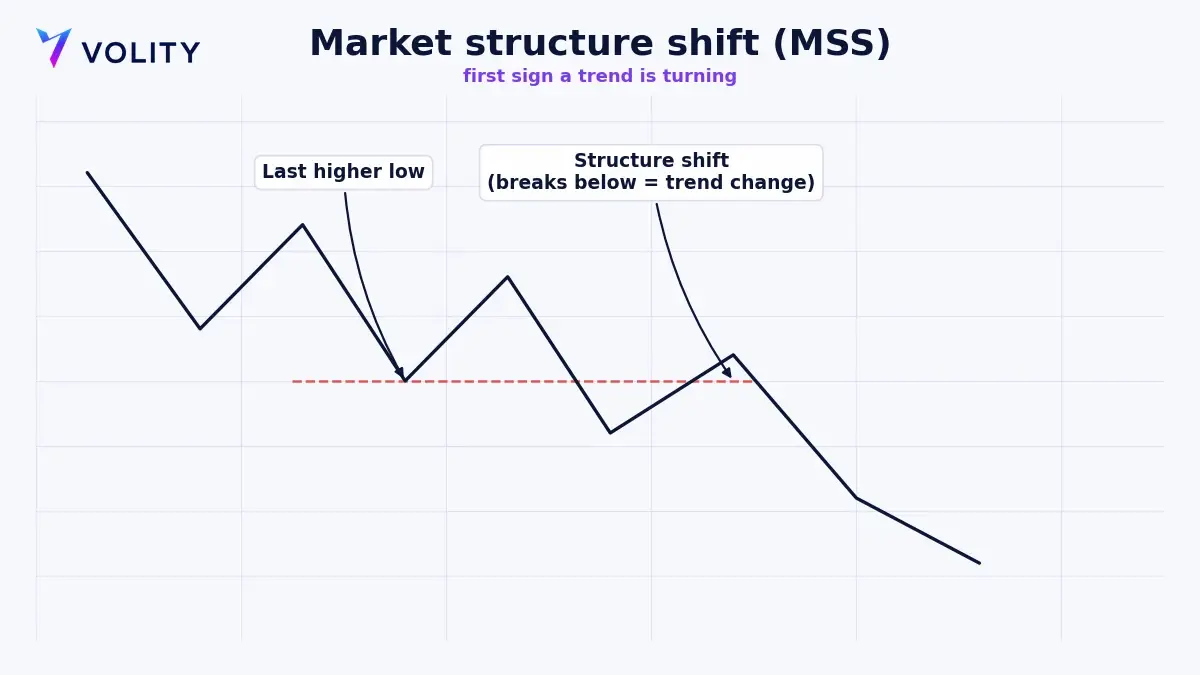
A market structure shift (MSS) is when price breaks a swing point against the prevailing trend with force, signalling a possible reversal. In an uptrend it breaks the last higher low; in a downtrend it breaks the last lower high. It is the first structural sign that a trend may be turning.
What is a market structure shift?
Every trend is protected by one key swing. In an uptrend, that swing is the most recent higher low; as long as it holds, the uptrend is intact. A market structure shift is the moment price breaks and closes through that protected swing in the opposite direction, on a decisive, impulsive move. The market structure that carried the trend cracks, and the odds of a reversal rise.
The emphasis on force matters. A slow, grinding break of the higher low is weaker than a wide candle that closes through it in one push. That impulsive quality, which smart-money traders call displacement, is what separates a genuine shift from ordinary noise. Read on a clean candlestick chart, the shift is the market changing its mind, and the displacement is how loudly it says so.

Market structure shift vs break of structure: what is the difference?
These two are mirror images, and confusing them is the fastest way to trade a reversal as a continuation, or the other way round.
| Feature | Market structure shift (MSS) | Break of structure (BOS) |
| Direction of break | Against the trend | With the trend |
| Signals | Possible reversal | Trend continuation |
| In an uptrend | Breaks the last higher low | Makes a new higher high |
| Trader response | Prepare for a turn | Join the existing trend |
A break of structure extends the pattern, while a market structure shift breaks it in the wrong direction. If you have read the BOS guide, the MSS is its opposite number, and the two together describe almost every turn on a chart.
Is a market structure shift the same as a change of character?
For most traders, yes. Change of character, or CHoCH, and market structure shift describe the same event: the first break of structure against the trend that flags a reversal. Some traders draw a fine line, using CHoCH for the initial break and MSS specifically for a break carried by strong displacement, treating the MSS as the higher-quality version. The distinction is more about vocabulary than mechanics, and you will see the terms used interchangeably across smart money concepts material.
How do you read a reversal with a market structure shift?
Work top down and keep it mechanical, the way sound technical analysis teaches. First mark the protected swing, which in an uptrend is the last higher low (a swing low the trend keeps respecting) and in a downtrend is the last lower high (a swing high).
- Establish the trend and mark its protected swing, the last higher low in an uptrend or last lower high in a downtrend.
- Watch how price approaches that swing. Often a final push takes liquidity beyond the trend’s extreme first.
- Look for a decisive candle that closes through the protected swing against the trend. That close is the shift.
- Confirm the move was impulsive rather than a slow drift. Displacement raises the quality of the signal.
- Mark the order block or fair value gap left inside the shifting move; that becomes your entry zone on the pullback.

How do you trade a market structure shift?
- Wait for the MSS to confirm with a body close through the protected swing.
- Mark the order block or fair value gap created by the impulsive move.
- Enter on the retracement into that zone instead of chasing the break.
- Place the stop beyond the recent extreme, which is often the high or low that was swept just before the shift.
- Target the next opposing structure or liquidity pool, a prior support or resistance zone, and manage as the new trend develops.
Trading the retracement instead of the break gives a tighter stop and a better price, the same discipline that makes any structure-based entry work.
What makes a market structure shift high quality?
- A liquidity sweep first. The best shifts come right after price runs the trend’s final high or low, taking stops before it turns. Research on how stop orders cluster in currency markets shows why those levels get hit, and a liquidity sweep followed by an MSS is a classic reversal sequence.
- Strong displacement. A wide, one-directional candle through the protected swing beats a hesitant one.
- Higher-timeframe agreement. An MSS on the 1-hour that lines up with a daily level or a daily shift is far stronger than one that fights the bigger trend.
- A clean target. A shift with obvious liquidity to aim for has a defined reason to run.
What are the common market structure shift mistakes?
- Calling every pullback a reversal. A normal retracement that respects the protected swing is not an MSS, because the swing has to break and close through.
- Ignoring displacement. A weak break of the swing often fails and the trend resumes.
- Fighting the higher timeframe. Reversals against a dominant daily trend need much stronger evidence.
- Entering at the break. Chasing the shift candle leaves a wide stop, so the retracement is the higher-quality entry.
What is a minor versus major market structure shift?
Not every shift carries the same weight, and grading them keeps you from calling a small wobble a full reversal. Traders usually separate a minor shift from a major one by the scale of structure it breaks.
- A minor market structure shift breaks a small, internal swing inside a pullback or range. It can signal that the current leg is turning, though on its own it does not reverse the larger trend.
- A major market structure shift breaks a significant swing that defines the higher-timeframe trend. This is the one that flags a genuine change in direction on the daily or weekly picture.
The two work together. A major shift on the daily chart sets the new bias, and a minor shift on a lower timeframe times the entry in that new direction after a retracement. Problems start when a trader sees a minor shift and trades it as if the whole trend has flipped. A small internal break against a powerful daily uptrend is far more likely to fail than a major shift confirmed across timeframes.
A quick example makes the grading concrete. Say EUR/USD is in a clear daily uptrend and dips on the 5-minute chart, breaking a tiny internal swing. That is a minor shift, useful only for timing a long once the daily trend resumes. If instead the daily candle closes below the last major higher low with real displacement, that is a major shift, and the reversal deserves attention on its own terms.
The habit to build is always asking which scale a shift belongs to before you act, a discipline that mainstream trading education reinforces. Grade the shift, then check whether the higher timeframe agrees before you demand displacement on the breaks that matter. A market structure shift read this way becomes a reliable reversal tool rather than a reason to fight every trend that pauses.
Putting the market structure shift to work on Volity
Catching a reversal early is valuable, but only if you can act on the shift without slippage eating the edge. Volity offers CFD trading across forex (the most heavily traded market in the world), indices, commodities, and crypto from a single account, so you can trade an MSS long or short on whichever market prints it. Leverage of up to 1:500 on forex lets you size to the stop beyond the swept extreme rather than to your balance, and the charts on the Volity platform mark protected swings clearly. You can open a Volity MT account for $0, rehearse the read on a demo, invest from as little as $1, and place your first trade from $1.
Leverage cuts both ways, and a shift that fails can move against you as fast as a good one runs. Regulators including the FCA and ESMA restrict how leveraged CFDs are sold to retail traders for that reason, so cap the risk on each trade and let negative balance protection backstop the rest. Volity operates under CySEC regulation through UBK Markets (licence 186/12). Check your instrument’s cost on the charges and fees page, and rehearse the read on a demo before trading it live.
Market structure shift FAQ
Is a market structure shift a reversal signal?
It is the first structural evidence of a reversal, though it never guarantees one. An MSS breaks the trend’s protected swing against the prevailing direction, which shifts the odds toward a turn. Confirmation improves when the shift shows strong displacement, follows a liquidity sweep, and agrees with a higher-timeframe level. Read on its own, it flags risk to the trend and asks for confirmation before you act.
What is the difference between MSS and CHoCH?
They usually mean the same thing: the first break of structure against the trend that signals a possible reversal. Some traders reserve MSS for a break carried by strong displacement and use CHoCH for any counter-trend break, treating the MSS as the higher-conviction version. In practice the terms are interchangeable in most smart-money material.
What timeframe is best for a market structure shift?
The 1-hour, 4-hour, and daily charts give the most reliable shifts. Many traders confirm the reversal on a higher timeframe and then use a lower one, such as the 5-minute or 15-minute, to time the entry after the shift. Lower timeframes alone produce frequent false shifts that the higher trend quickly reverses.
Does a market structure shift need displacement?
The strongest shifts do. Displacement, a wide and impulsive candle through the protected swing, shows that real order flow drove the break rather than passive drift. A shift without displacement is weaker and fails more often, so many traders require an impulsive close before treating the break as a genuine market structure shift.