Market pulse: profits beat size as traders sift the tape
The market has a taste today for cleaner profits, not bigger stories. That matters across healthcare, banks and AI infrastructure.
UnitedHealth Group, PNC Financial and Taiwan Semiconductor sit in very different neighbourhoods. However, each carries the same question. Can management protect margins while still funding growth?
For traders, that makes this a tape for research and stress tests. It does not hand out simple buy or sell instructions.
Healthcare: margins before membership
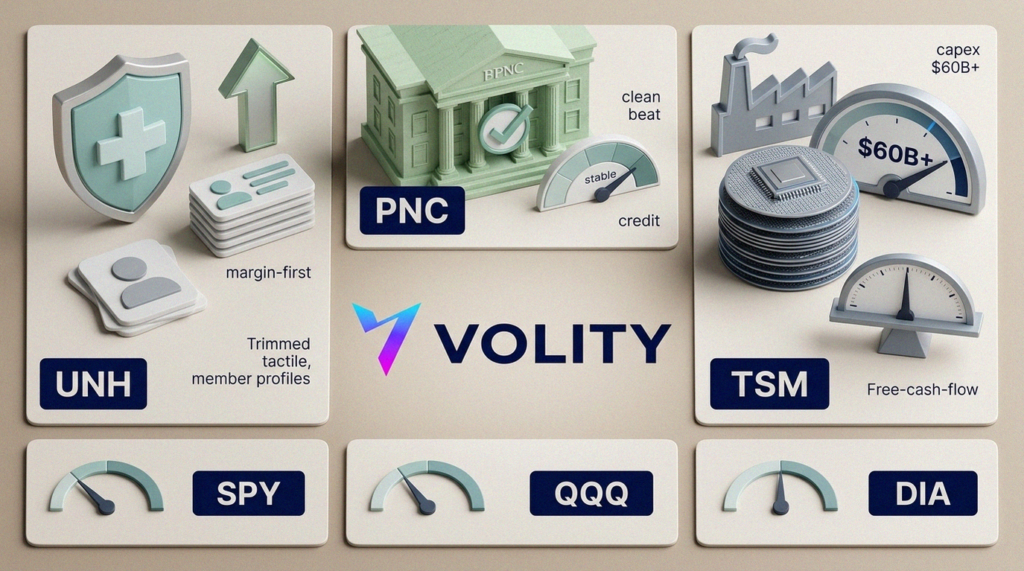
UnitedHealth Group, ticker UNH, has chosen earnings quality over brute scale. The insurer is trimming roughly 1 million Medicare Advantage members. Meanwhile, it raised full-year earnings guidance.
That combination gives investors something unusually clean to debate. Fewer lives normally sound like a setback. However, lower exposure can help repair margins after last year’s medical-cost shock.
UnitedHealth is effectively telling Wall Street that it prefers profitable members to trophy membership numbers. The stock may trade less like a wounded insurer and more like a defensive compounder.
Options desks will focus on guidance durability. Equity traders, meanwhile, will watch whether investors keep rewarding margin discipline. If they do, falling membership may matter less than feared.
Financials: banks get rewarded for clean beats
PNC Financial, ticker PNC, has delivered the kind of quarter bank bulls like. Earnings beat expectations, revenue came in ahead, and management sounded comfortable on growth.
Net interest income helped the story. Fee growth added another leg. Meanwhile, analysts remain broadly constructive, with a buy-leaning consensus and upside still embedded in targets.
That makes PNC a useful barometer for financials. If rates and credit stay calm, traders may keep treating dips as opportunities. However, that view depends on the macro backdrop behaving itself.
CTAS and BLK sit in a similar post-earnings bucket. Both have the right ingredients for trend-following desks: solid execution, friendly target moves and institutional comfort.
By contrast, FAST needs more patience. Its headline results looked more in line, although sales growth stayed healthy. So the trade is simpler. Watch whether momentum extends or fades.
PGR looks more fragile. Revenue held up, but earnings and net income slipped. Traders are likely to map support zones and keep position sizes restrained.
AI infrastructure: growth meets the spending bill
Taiwan Semiconductor, ticker TSM, remains the toll road for the AI build-out. Demand from AI servers continues to run hot. However, the company is also spending heavily to keep pace.
Annual capital expenditure above $60 billion keeps the debate alive. Growth investors see capacity, pricing power and share gains. More cautious holders see a large bill arriving before final returns are clear.
This is the central tension across the AI trade. Revenue can look spectacular while free cash flow takes punishment. Earnings quality now matters as much as demand commentary.
Further down the risk curve, APLD and BE offer more speculative exposure. Applied Digital leans into data-centre demand. Bloom Energy gives traders a power-infrastructure angle, without the megacap cushion.
Those names can move fast. However, they suit smaller sizing and stricter risk limits. They are expressions of AI infrastructure, not broad-market anchors.
Alphabet, through GOOG and GOOGL, adds another live earnings setup. Traders will parse cloud growth, ad demand and AI spending. Meanwhile, technicians will frame the stock around breakout and breakdown levels.
ASTS trades differently. Satellite connectivity gives it a strong story, but daily moves often reflect risk appetite. In a hot tape, it can run. In a weak one, it can deflate quickly.
Macro lens: rotation matters more than slogans
Index futures set the tone before company stories get their chance. Today’s mix points to uneven appetite. The Dow looks firmer, while the S&P 500 feels softer.
Meanwhile, Iran-related headlines keep geopolitical risk on the desk. That does not create a straight line to any single equity. However, it can affect energy, defence, index hedges and volatility pricing.
Traders are therefore watching SPY, QQQ and DIA as rotation gauges. High-beta names such as JBHT, ASTS and ATAI can then show where risk appetite concentrates.
The useful question is not whether one headline caused one stock move. It is whether the session behaves like a beta chase, a defensive rotation, or a headline market.
Event risk: deals and financing bring sharp edges
Uber, ticker UBER, has a genuine catalyst on the board. Its roughly $14.8 billion proposal for Delivery Hero would deepen its delivery footprint.
The company already reaches about 99 markets. The strategic logic is clear enough. Scale can help logistics, merchant relationships and consumer frequency.
Still, the risks are just as visible. Regulators may press hard. Integration can drag. Meanwhile, changes in deal terms can jolt the stock before fundamentals catch up.
GRRR sits at the opposite end of the market-cap spectrum. Its $125 million convertible bond for the NeutraDC Batam project raises classic questions. Investors will weigh dilution, interest costs and project execution.
Convertible deals rarely trade on one clean interpretation. Growth bulls see financing for expansion. However, existing holders often see a larger share count lurking nearby.
Sector setups: overbought screens and cyclical tests
High-RSI names such as FORR, KRT and LZ now sit on mean-reversion screens. Overbought does not mean broken. However, it does invite tighter stops and hedging checks.
In housing, LEN faces softer expert sentiment rather than obvious fresh damage. That can still matter, especially when homebuilders already carry rate sensitivity.
ROAD offers a cleaner infrastructure angle. Construction Partners ties into public spending, road work and consolidation. It may attract investors seeking domestic construction exposure.
Metals bring their usual pre-earnings tension. STLD and AA head into results with defined earnings expectations and familiar cyclicality. Traders will compare implied volatility with likely realised moves.
Alcoa also offers a modest income angle through its dividend. Still, aluminium pricing and macro demand will drive the larger move.
Flow watch: television names and transcripts
Television mentions rarely rewrite a company’s value. However, they can tilt attention for a session. Today’s “Final Trades” type names include META, VST, TROW and LLY.
Short-term traders should watch opening volume, options flow and whether price confirms the attention. If the mention fights the chart, the pop can fade quickly.
Fresh transcripts also deserve more respect than they get. MAN can reveal labour demand, wage pressure and employer caution. Meanwhile, GE offers detail on aerospace backlogs, margins and capital spending.
Together, those reads help frame cyclicals. They also give equity desks a grounded check on the broader economic story.
By the numbers
- 1 million – approximate Medicare Advantage lives UnitedHealth is cutting.
- $60 billion-plus – annual capital expenditure at Taiwan Semiconductor.
- $14.8 billion – approximate Uber proposal tied to Delivery Hero.
- 99 markets – Uber’s rough global market reach.
- $125 million – GRRR convertible financing for NeutraDC Batam.
Key takeaways
- UNH is a margin-quality story, not a membership-growth story.
- PNC and select financials still have earnings-momentum support.
- TSM keeps the AI boom tied to a large capex debate.
- UBER now carries event risk around deal terms and regulation.
- SPY, QQQ and DIA remain the cleanest read on rotation.
The market is offering stories with real movement behind them. Yet the best use remains disciplined. Treat these tickers as inputs for a process, not as ready-made trade tickets.
Related coverage on Volity
- What Is a P/E Ratio and How to Use It
- Fundamental Analysis in Stock Trading: A Working Definition
- Growth Investing vs Value Investing: Which Style Fits You?
- Fractional Shares Explained: How to Start Investing With $50
- How to Start Stock Trading: A 2026 Beginner Guide
- Dividend Investing for Beginners: How to Start